Top QA Automation Frameworks Compared: 2026
Summarize With:


Most CTOs and QA leaders at mid-sized SaaS companies come to this decision with three names in mind: Playwright, Selenium, and Cypress. That's a useful starting point, but it leaves out several test automation tools that may fit your team better depending on what you're testing, who maintains the suite, and what evidence your product has to produce.
We've grouped the frameworks the way our internal QA teams use them across client work; what works, what breaks, and where each tool stops being the right answer. Pick the scenario that matches your product.
Quick Framework Match
Use this table to find the closest starting point for your team. The sections below explain why each recommendation changes by product surface, team skill set, and compliance context.
| Scenario | Team Context | Best Starting Framework |
| New web automation project | JS/TS team, non-regulated | Playwright |
| New web automation project | JS/TS team, regulated | WebdriverIO v9 |
| New web automation project | Java-heavy team | Selenium (after a root-cause audit) |
| New web project, business-led QA, regulated | Packaged apps (SAP/ERP), codeless | Tricentis Tosca |
| Existing web suite | Any language/compliance | Start with the migration audit (Scenario B) |
| Web + mobile coverage | One stack across browser + native | WebdriverIO + Appium |
| Load / performance testing | API-level load alongside web E2E | k6 |
| Manual-QA-heavy, low maintenance goal | Plain-English authoring, vendor-managed upkeep | testRigor / mabl |
| Regulated documentation | Python shop where tests must stay business-readable | Robot Framework |
| Agentic testing across web, mobile, API, and enterprise apps (SAP, Salesforce) | QA teams consolidating multiple tools into one owned suite | ACCELQ |
At-a-Glance Feature Comparison
Filter on hard constraints; language, protocol, mobile, license, before reading the scenario detail.
| Framework | Language(s) | Protocol | Auto-wait | Mobile Native | License | AI / Agent-native | Best-fit team |
| Playwright | JS/TS, Python, Java, .NET | CDP + BiDi | Yes | No | Open source (MIT) | Yes (Test Agents) | JS/TS, new, non-regulated |
| Selenium | Java, Python, JS, C#, Ruby | WebDriver (W3C) | No | No | Open source | No | Java-heavy, big hiring pool |
| Cypress | JS/TS | In-browser | Yes | No | Open source + Cloud | No | JS/TS, single-tab |
| WebdriverIO v9 | JS/TS | WebDriver BiDi (W3C) | Yes | Yes (Appium) | Open source | Partial | Regulated, web+mobile |
| TestCafe | JS/TS | URL injection | Yes | No | Open source | No | Legacy / migrate |
| Puppeteer | JS/TS | CDP | Manual | No | Open source | No | Chrome-only scripting |
| Tricentis Tosca | Codeless (model) | Proprietary | Yes | Add-on | Commercial | Yes (Vision AI) | Regulated enterprise, SAP/ERP |
| Nightwatch.js | JS/TS | WebDriver / CDP | Yes | Appium | Open source | No | JS team, integrated runner |
| Katalon | Low-code + Groovy | Selenium/Appium | Yes | Yes | Commercial (freemium) | Yes (StudioAssist) | Non-eng QA, <500 tests |
| Robot Framework | Python (keyword) | Selenium/Playwright libs | Lib-dependent | Appium lib | Open source | No | Python, regulated docs |
| Appium | Java, Python, JS, Ruby | WebDriver | Yes | Yes (primary) | Open source | No | iOS/Android native+hybrid |
| k6 | JS | Protocol-level | n/a | No | Open source + Cloud | No | API/protocol load testing |
| testRigor | Plain-English | Cloud | Yes | Yes | Commercial | Yes (AI-native) | Manual QA, low maintenance |
| mabl | Low-code | Cloud | Yes | Yes | Commercial | Yes (AI-native) | SaaS, auto-heal |
| ACCELQ | Codeless (model-based), Groovy extension | Proprietary engine (Selenium/Appium under the hood) | Yes | Yes | Commercial | Yes (Agentic AI, self-healing, AI test generation) | QA teams using Agentic AI to consolidate web, mobile, API, and packaged-app testing in one platform |
Note: Open-source frameworks are free to run; cost shifts to execution grids (BrowserStack, Sauce Labs, LambdaTest) and commercial platforms (Tosca, Katalon, testRigor, mabl). Factor in execution infrastructure, not just license.
Read our full comparison report between playwright vs selenium vs cypress
Scenario A: Starting a New Web Automation Project
Two tools compete for this surface. The deciding question is whether your compliance environment requires a W3C-standard, vendor-neutral test stack for audit purposes. If it does, choose WebdriverIO. If it doesn't, choose Playwright.
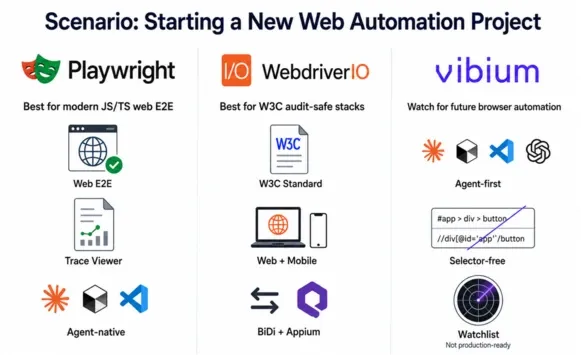
Vibium is not production-ready today, but it matters because it shows where browser automation is heading. A CTO making a five-year infrastructure decision should understand the direction.
Playwright
Playwright - Microsoft's CDP-based framework. Auto-wait, trace viewer, parallel execution, multi-tab handling, and network interception ship in the box. As of v1.56 (October 2025), it also ships LLM-driven Test Agents that plan, generate, execute, and self-heal without a third-party plugin. It led developer satisfaction at 91% in State of JS 2025 the highest in this comparison.
In a controlled study, TTC Global measured 24.9% average time savings (range 12.8–36.2%) using Playwright MCP plus GitHub Copilot on real Workday HRIS automation — while noting 15–30% of AI-generated tests still needed human rework. Saleor's migration is the caution: their suite got more reliable largely because the team cleaned up and rewrote weak tests, not from the framework switch alone.
Right fit: A new JS/TS web E2E project where developer experience and agent-native testing matter.
Wrong fit: when compliance requires a W3C-standard stack (CDP is a five-year audit risk), or when your real problem is a broken wait strategy.
Exploring Playwright or Playwright MCP for Your Team? Talk to a Playwright Engineer.
WebdriverIO v9
WebdriverIO v9 - Built on WebDriver BiDi, a W3C standard shipped natively by Firefox and Chrome. It's the only mainstream option here that unifies web E2E and mobile native testing through Appium under one driver architecture.
The trade-off: developer reports note v9 execution-time regressions on shadow-DOM-heavy apps, validate it against your own patterns first.
Right fit: Healthcare/Fintech products needing W3C-standard audit trails, or teams running web + mobile on one architecture.
Wrong fit: Shadow-DOM-heavy apps you haven't benchmarked on v9.
Vibium (watchlist)
Vibium is an agent-first, selector-free test automation framework built by Jason Huggins, the engineer who created Selenium in 2004. Instead of maintaining CSS or XPath selectors, Vibium is designed for an MCP-based testing model where agents read the page structure more semantically. As of mid-2026 it lacks the production footprint of Playwright, WebdriverIO, or Selenium. Its importance is directional, worth tracking, not standardizing on yet.
What ThinkSys checks before any new-project recommendation
Before we recommend a new framework, we first check the constraints that will still matter after the tool is installed.
- If your product is HIPAA-bound, subject to FDA 21 CFR Part 11, or preparing SOC 2 evidence, the protocol choice matters more than developer preference. That can move the recommendation from Playwright to WebdriverIO.
- If your automation team is Java-heavy, choosing Playwright only for satisfaction scores creates a skills gap. The better recommendation may be Selenium or a phased adoption plan.
- If your roadmap includes AI-assisted testing, the five-year view matters. Playwright Test Agents are already shipped, while Vibium is still directional.
Scenario B: Already Running a Web Automation Suite
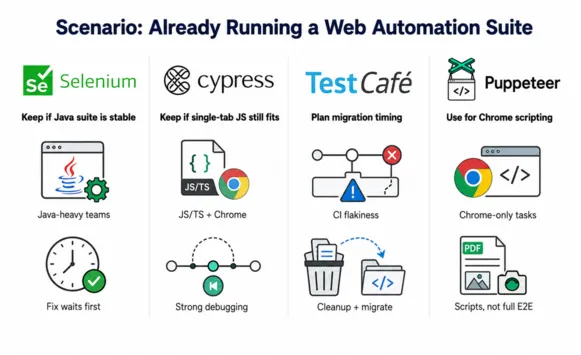
Run a root-cause audit before any migration. Microsoft Research (Lam et al., 2019) documented async waits, concurrency, and test-order dependency as the dominant flakiness causes — none of which a framework change removes. If 70%+ of your failures trace to test design, fix the design first.
Selenium
The original framework: WebDriver protocol, Java-native, 15+ years of libraries, multi-browser by default, no native auto-wait. Selenium isn't inherently flaky, suites written without wait discipline are.
Right fit: disciplined suites in Java-heavy orgs where hiring depth matters.
Wrong fit: when async waits and test data drive most of your failures.
Cypress
JS-only, runs inside the browser, with the best time-travel debugging experience for front-end engineers (72% satisfaction in State of JS 2025).
Right fit: a well-maintained suite on a Chrome-primary, single-tab product.
Wrong fit: when multi-tab, multi-origin, or multi-language requirements appear.
Nightwatch.js: An all-in-one JS runner sitting between Selenium's flexibility and Cypress's batteries-included feel.
Right fit: JS teams wanting an integrated runner without single-context limits.
Wrong fit: when you need Playwright's agent tooling or cross-language support.
Puppeteer
A Chrome-only CI scripting tool, not a primary E2E suite. In GoDaddy's 2018 move from WebdriverIO/Selenium to Puppeteer, the framework caused no CI flakiness over five months — but GoDaddy flagged it isn't suited to multi-browser needs.
Right fit: Chrome-specific scripting (screenshots, PDFs, form filling).
Wrong fit: as your primary suite when Firefox/Safari matter.
TestCafe
A JavaScript E2E framework using URL-injection architecture, with no WebDriver and no CDP. It got approximately 100,000 weekly npm downloads in February 2026, with a steady decline. PostHog moved from TestCafe to Playwright after CI flakiness on BrowserStack became a maintenance problem.
Wrong fit for new adoption. The migration decision is already made for most teams; AI-assisted migration changes the timeline from a multi-quarter project to a weeks-scale project for many 300-to-400-test suites.
What ThinkSys checks before recommending migration
- Is it the framework or the test design? If failures cluster around async waits, locators, test data, or environment instability, the fix is refactoring, not a tool swap. We separate framework limits from test-design debt before any migration plan.
- Who owns the suite? Weak ownership or poor structure moves with the suite into any new framework. We confirm suite discipline before recommending a tool change.
- What's the real migration cost? For legacy suites (e.g. TestCafe), we estimate the AI-assisted migration path first, a three-week move and a multi-month move are very different business decisions.
Stuck deciding whether to fix or migrate a flaky suite? Get a Root-Cause Audit.
Scenario C: Non-Engineering QA Team Writing Tests
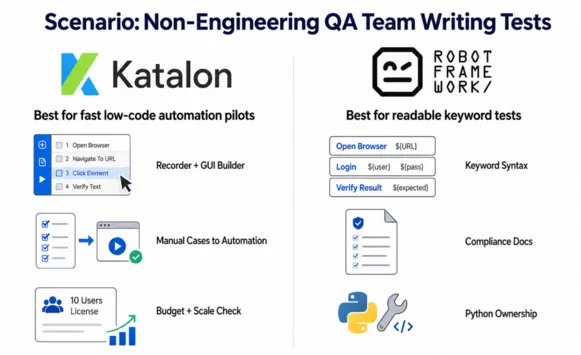
Low-code frameworks help teams start automation with limited engineering bandwidth — but the risk appears later, when the suite needs branching logic, source control, and CI ownership.
Katalon
A commercial low-code platform built on Selenium and Appium, covering web, mobile, API, and desktop. In Katalon's Care Logistics case study, automation cut the regression cycle roughly in half. The caution: as suites scale, teams often need custom Groovy and engineering ownership the low-code pitch understates.
Right fit: a non-engineering QA hire, hard deadline, under 500 tests, clear budget owner.
Wrong fit: a suite heading toward 1,500 tests with no code-first migration trigger defined.
Robot Framework
Python-based, keyword-driven, with readable syntax for non-engineers; strong in regulated industries where tests double as compliance documentation. The common failure mode: complex logic drifts back into Python, leaving two layers to maintain.
Right fit: Python-comfortable teams in regulated environments with a QA engineer governing the keyword library.
Wrong fit: when the whole premise is that non-engineers maintain it long-term.
How ThinkSys sets the low-code exit point
Before we recommend a low-code framework, we define when the team should stop adding to it and move to a code-first suite.
- We check who will own the suite after the first year, not who can create the first tests. Release pressure usually moves ownership from non-engineering QA to the people responsible for CI stability.
- We set the scale target before the tool decision. A 200-test suite and a 1,500-test suite need different maintenance models.
- We define the migration trigger before adoption. That trigger should include test count, customization level, CI failure rate, and the point where a code-first framework becomes cheaper to maintain.
Scenario D: Mobile or Performance Coverage
Once web E2E is covered, the next question is usually mobile or performance. This is where teams often make a category mistake: Appium and k6 are useful tools, but they do not replace the browser regression suite.
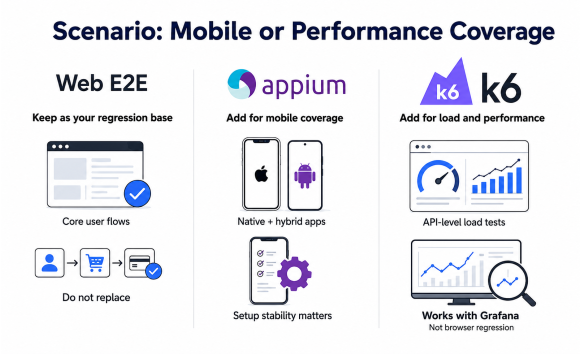
Appium covers native and hybrid mobile behavior. k6 covers load and performance at the API or protocol layer. If a team uses either one as proof that the full product is covered, it creates a blind spot. Mobile tests will not tell you whether your web checkout still works, and a passing load test will not tell you whether the user flow is correct under that load.
Use these tools to extend coverage, not to substitute for the web E2E layer.
Appium
The open-source default for mobile native and hybrid testing (iOS via XCUITest, Android via UiAutomator2), supporting Java, Python, JS, and Ruby. Setup complexity—Xcode, Android SDK, simulators, and driver compatibility is the recurring hurdle before reliable cloud runs.
Right fit: iOS/Android native or hybrid apps; pair with WebdriverIO for one web + mobile architecture.
K6
A JS-based load and performance tool from Grafana Labs for API/protocol-level testing, with native Grafana dashboard integration. Note its custom JavaScript runtime (not Node) and browser-flow limits. A passing load test proves the system responds under load, not that checkout still works correctly under it.
Right fit: Grafana-stack teams needing API load testing alongside web E2E.
Wrong fit: treating performance coverage as a substitute for browser regression.
What ThinkSys checks before extending coverage
Before we add mobile or performance automation, we confirm that the new tool is expanding coverage rather than hiding a gap in the existing test strategy.
- For Appium, we treat setup as architecture work. Device targets, simulator versions, cloud execution, and driver compatibility need a stability plan before test-writing velocity becomes the priority.
- For k6, we confirm that web E2E coverage already exists. If k6 replaces browser regression tests, the team has measured load without proving that critical user flows still work.
- For teams that need both web and mobile coverage, we evaluate WebdriverIO plus Appium before creating two unrelated stacks. One driver architecture usually means less long-term QA maintenance.
Scenario E: AI-Native / Autonomous Testing
By 2026, the real shift is whether part of your suite should be authored and maintained by an AI agent. Two patterns coexist: AI agents layered on code-first frameworks (Playwright Test Agents, MCP), and AI-native platforms (testRigor, mabl, Applitools) that move authoring into plain English or recorded intent. The trade is ownership versus speed.
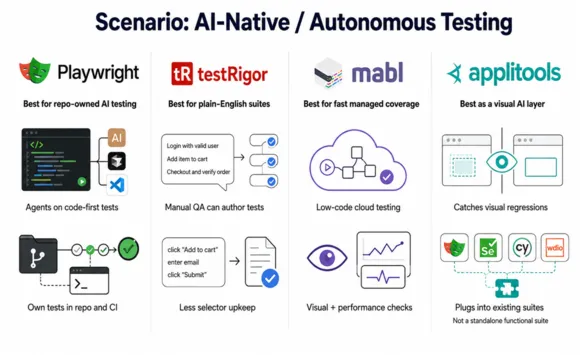
testRigor
Plain-English authoring so manual QA can build and maintain suites without selector upkeep.
Right fit: large manual regression backlog, limited automation engineering.
Wrong fit: when you need open-source portability or tests inside your own repo and CI.
Mabl
Low-code, cloud, with auto-healing plus built-in visual and performance checks.
Right fit: SaaS teams wanting fast, managed coverage.
Wrong fit: compliance requiring a self-hostable, vendor-neutral stack.
Applitools
A visual-AI layer that plugs into Playwright, Selenium, Cypress, and WebdriverIO to catch visual regressions functional assertions miss.
Right fit: design-system-heavy products.
Wrong fit: as a standalone functional suite.
ACCELQ
Agentic AI turns a single business-process model into test coverage across web, mobile, API, and packaged apps like SAP and Salesforce, generating and self-healing tests without hand-written scripts.
Right fit: Teams testing across web, mobile, API, and packaged apps who want one platform instead of stitching tools per surface.
Wrong fit: Small teams with a single web codebase, or teams fully committed to a code-first stack who want test logic living in their own repository.
What ThinkSys checks first
Where test ownership must live (a proprietary cloud engine is a lock-in risk under audit/IP constraints), and whether you'd get most of the benefit from Playwright's agents without giving up framework ownership.
Evaluating AI-native vs agent-based testing? Talk to a QA Automation Engineer.
Conclusion
The best automation framework is rarely the one with the loudest market signal. It's the one that fits your product surface, team skills, compliance needs, test-data model, CI stability, and maintenance ownership.
If your team is stuck between two frameworks, or your current suite is flaky enough that every option looks risky, the next step isn't another feature table, it's an architecture audit.
ThinkSys has helped mid-sized SaaS teams decide which framework to keep, which to migrate from, and which gaps to fix first, and we back qualifying QA partnerships with a zero critical bug guarantee.
Not sure which framework fits your product? Book a Free QA Automation Audit.