7 Signs Your Development Team Needs a QA Testing Partner
Summarize With:


A dedicated QA testing partner is an independent quality function embedded in your sprint cadence but architecturally separate from the developers who write the code, that governs what AI generates, owns regression strategy, and holds release-quality authority your feature builders structurally cannot.
AI-assisted teams ship faster and break more at the same time because the tools added throughput without adding governance. These seven signs reveal whether your team has crossed that line. Score 3+ and you're accumulating quality debt that surfaces as a support crisis in roughly six months; score 5+ and it's already costing you 1-2 engineers' sprint capacity every month.
This article is for CTOs and engineering leaders at SaaS companies with 10-40 developers who have adopted AI testing tools in the last year and are still seeing production quality degrade.
AI-assisted teams are shipping faster and breaking more simultaneously, because they lack an independent quality function to govern what AI generates. When teams like yours come to ThinkSys, we almost always identify one or more of these same seven structural signs.
Here is how to find each one in your pipeline and a scorecard at the end to total your result.
Get the Free 7-Sign QA Diagnostic Scorecard
Sign 1: Your CI pass rate and your production incident rate are moving in opposite directions
On July 19, 2024, CrowdStrike's test suite passed, and its Content Validator ran yet 8.5 million Windows machines went into a boot loop because there was no independent layer above the test to catch the test's own logic error.
CI passing is evidence that the code satisfies the assumptions built into the test, but it's not evidence that the assumptions are correct. When your team writes the code and the tests, the tests inherit the same blind spots. A validator that passes a malformed template has a logic error that only surfaces when someone tests the validator itself.
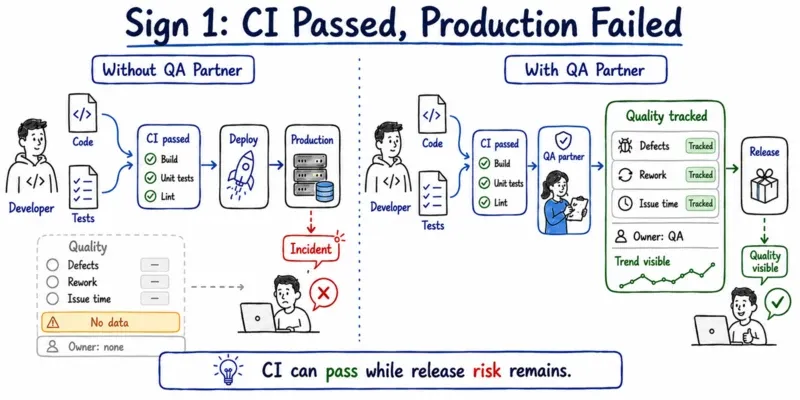
CrowdStrike's own Root Cause Analysis (Channel File 291, Aug 6, 2024) confirmed this structural gap. Post-incident commitments included "improved test coverage, additional stability and content interface testing, staggered deployment for Rapid Response Content." Every commitment was the reinstatement of an independent QA layer that had been absent.
How to find this sign: Pull your last 90 days of CI pass rate alongside production incident count. If they're moving in opposite directions, your tests are validating assumptions no one has independently questioned.
The diagnostic question: How many of those incidents had a test that was green in CI, yet the bug still reached production?
How ThinkSys handles this
We start by separating "tests pass" from "assumptions validated." We audit your highest-incident modules and inventory the implicit assumptions your test suite has never explicitly stated - the wildcard-in-slot-20 class of gap that took down CrowdStrike. Then we install a review layer: a non-builder who questions what the tests assume, not just whether they run green. That single architectural addition is what CI alone can never provide.
Green CI means your tests are passing, which is a different statement from "an independent skeptic has validated what the tests assume." Next, we’ll see what happens when AI widens that gap faster than your team can close it.
Sign 2: Your AI tools are generating tests faster than your team can govern them
In 2025, 68% of organizations were using or planning to use generative AI for quality engineering. The Capgemini World Quality Report 2024-25 found that 57% still named the same top automation blocker for three consecutive years (lack of a comprehensive test automation strategy). The tools arrived, but they did not solve the issues.
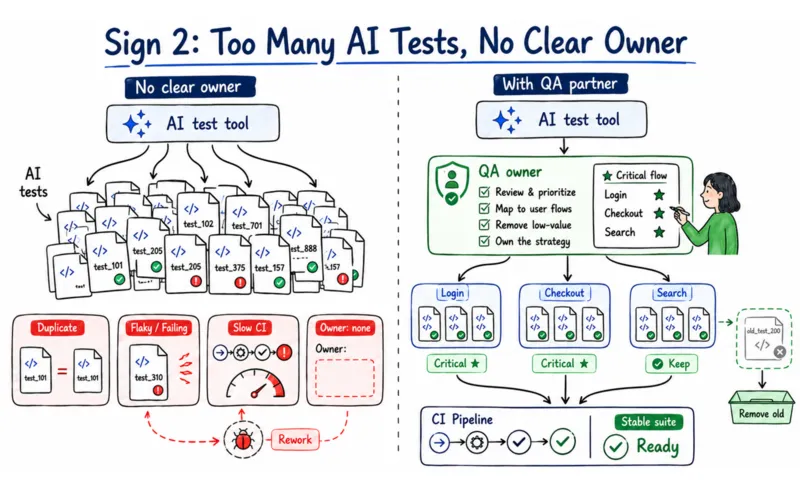
DORA 2025 measured that AI-assisted teams with the highest test generation throughput also showed the fastest-rising rework rates. A tool generates tests. A strategy decides which tests protect which user flows, who is accountable when a new feature ships, and which coverage to prioritize when a deploy breaks something.
Without a strategy owner, AI-generated tests accumulate on top of an ungoverned foundation. When the suite degrades, no one has the authority to triage it.
How to find this sign: Ask your team - Who made the last decision about which tests to deprecate when the suite got too slow to run in CI?
If the answer is "no one in particular," AI is adding volume on top of an ungoverned foundation every sprint.
How ThinkSys Handles This
When we embed with a team that has ungoverned test automation, we start by mapping the suite's decay rate. Here we measure the ratio of active tests to silenced ones over the last six months. A test disabled by decision is different from one turned off to keep CI green, and that distinction tells us immediately whether any governance function ever existed.
From there, we trace the last five deprecation decisions to whoever made them. If there is no named owner with a priority framework, the governance gap is confirmed, and we establish one before touching anything else.
We do not add AI-generated tests until a regression prioritization protocol is in place. Adding more tests to an ungoverned suite just makes the problem more expensive to fix later.
Proof point: When we engaged Boostlingo, their legacy automation couldn't keep pace with release velocity. We installed governed regression architecture before scaling coverage, cutting QA cycle time from 5-7 days to ~2 hours while expanding coverage from ~70% to ~100%.
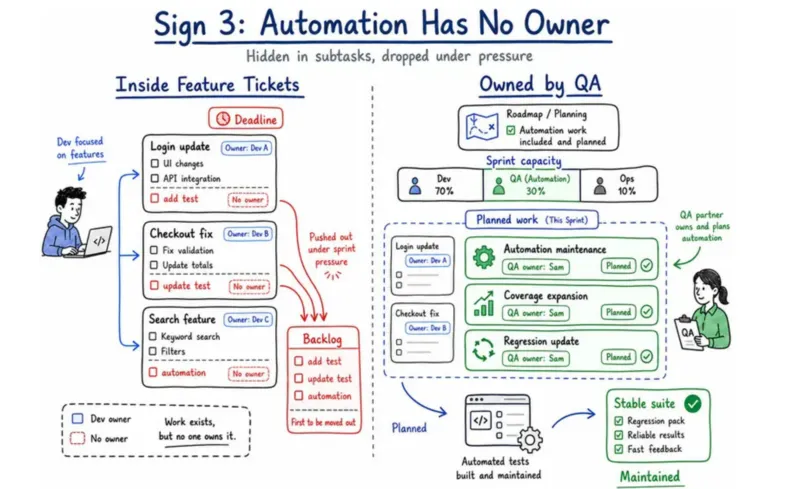
Sign 3: Your test automation lives inside sprint subtasks
When there is no dedicated QA owner, test automation has no legitimate place in the sprint. It gets squeezed into feature tickets, treated as optional effort, and dropped at the first deadline because it was never officially allocated in the first place. It is a structural problem: the work has no sponsor, no roadmap entry, and no claim on sprint capacity. When QA is absorbed into developer headcount, automation work exists at the discretion of developers who are also evaluated on feature throughput. Under deadline pressure, it moves to the backlog, not deprioritized but made invisible, because it was never on the roadmap in the first place.
Developers have always been capable of writing tests. What dedicated QA provided was not that capability but an independent owner, someone whose job was to question the product, not build it. That is why 57% of organizations lack a comprehensive test automation strategy, not because they lack tools, but because they lack a function with the mandate to build one.
How to find this sign: Did your team allocate any capacity to automation maintenance or coverage expansion as a standalone story with a named owner in the last three sprints?
If automation only appears as subtasks inside feature stories, it has no structural owner and will decay under velocity pressure every sprint.
How ThinkSys handles this
We give automation a structural home it can't be evicted from. First, we establish automation as a named workstream with its own sprint allocation, not subtasks borrowed from feature tickets. Second, we assign a dedicated owner accountable for coverage expansion and maintenance, separate from the developers shipping features. Because our team's throughput isn't measured on feature velocity, automation work can't get silently traded away under deadline pressure the way it does on an internal team. The work finally has a sponsor whose only job is protecting it.
When automation has no owner, the next person with no conflict of interest who reviews released code is your customer.
Sign 4: Your customers are finding defects before your release validation does
When companies treat QA as optional, defects reach customers instead of being caught before release. Support queues grow, developers get pulled into reactive debugging, and your team ends up spending more engineering time on fixes than a dedicated QA function would have cost. Support tickets are a structural signal, not just a customer experience problem. They indicate that independent validation has moved outside the pipeline and onto the paying customer.
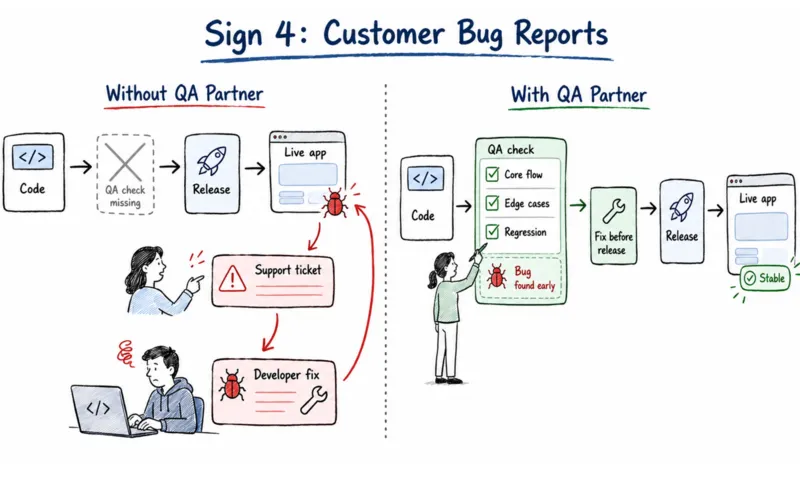
NIST's research found production defects cost 30x more to fix than design-stage defects. For a 25-developer team that ships 20 defects to production per month at 12 hours mean recovery time, that is 240 engineering hours per month, roughly 1.5 FTEs consumed by rework that earlier independent detection would prevent. Your team feels it as slower sprints and a worsening on-call rotation, never as a budget line anyone can point to.
How to find this sign: Track customer-reported defects as a percentage of total defects found, against the period when your AI-tool adoption increased. Per DORA 2025, without an independent feedback layer that percentage rises as AI throughput grows.
How ThinkSys Approaches This
The first number we pull is customer-reported defects as a percentage of total defects found, tracked against the period when your AI tool adoption increased. DORA 2025 confirmed this pattern: without an independent feedback layer, that percentage rises as AI throughput grows.
We then map the 90-day defect escape rate against the period when your team relied on developer-only QA. The trend line matters more than any single number.
Finally, we calculate what escaped defects actually cost last quarter. We put that number next to the cost of independent QA coverage before the next budget cycle opens. That comparison usually closes the conversation.
Proof point: Anyone Home cut support tickets 25% and reduced post-release bugs 20% after we moved independent validation back inside their pipeline, and issue resolution got 40% faster.
Sign 5: Your feature builders are your primary QA reviewers
A developer who builds a feature has a natural stake in it working. That stake shapes how they test it, and the gaps it creates are invisible to them. The problem is structural, not a question of skill or discipline: when you build something, your mental model of how it works becomes the lens through which you test it. Independent QA brings a different mental model, one with no investment in the assumption being tested. Building software and finding its flaws require opposite instincts, and no amount of tooling changes that. The function must be architecturally separated from the maker.
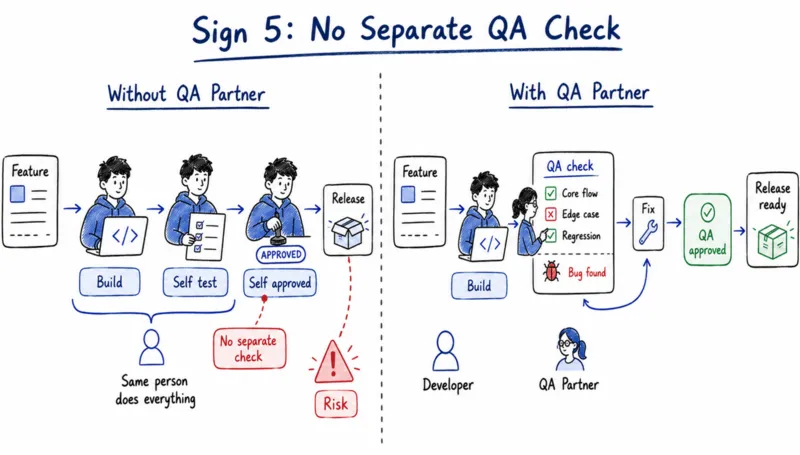
Gergely Orosz, who writes The Pragmatic Engineer newsletter and spent years inside engineering at Uber, documented what happens when the "QA-less" Big Tech model gets misread. In a 2024 piece on how Big Tech actually handles quality: "Even this year I heard of a Silicon Valley-based company where a developer team has the test team write unit tests." The SDET (a software engineer whose role is quality automation, not feature development) became the developer's testing assistant rather than the independent skeptic. That is exactly what the slogan does not warn you about.
How to find this sign: Audit your last five releases - who authorized production deployment, and was any non-builder in that decision path?
If the developer who built the feature authorized every deployment, your pipeline has no independent checkpoint. .
How ThinkSys Approaches This
First, we examine the authorization log from your last five deploys: who approved production, and what was their relationship to the code? One non-builder in that list changes the picture entirely.
Now, the obvious objection: "I'm not giving an external vendor veto power over my production deploys." You're right, and we don't ask for that. Independent quality authority doesn't mean an outside party unilaterally blocking your releases. It means a defined quality gate where our QA lead issues a documented ship / hold recommendation against your agreed Definition of Done, backed by your engineering leadership's authority. The independence is in the assessment - a non-builder evaluating against external criteria, not in seizing control of your pipeline. Your VP Engineering or CTO retains the final call; what changes is that the call is now informed by an independent signal instead of builder confidence alone. In practice, teams that adopt this almost never override a hold, because the recommendation comes with the specific evidence behind it.
That's the structural fix the highest-performing teams have and the rest don't: a role with the standing to say "not yet," architecturally separated from the people who built it.
When no one can block a release, "done" is whatever the developer decides, and the cost accumulates slowly with no headline and no postmortem.
Sign 6: Your Definition of Done has no criterion that a non-builder can verify
Jeff Putz is a software developer who led his team through a deliberate decision to remove dedicated QA. After living with the outcome, he described what happened on LinkedIn in July 2025: "Without QA, I think we slip into a mode of what we think is good enough. When there's no separate person to only test, no one is there to say, 'That story is not fully baked.'" No production incident, no postmortem, just compounding quality decay that shows up three months later as slower sprints and a support queue that will not flatten.
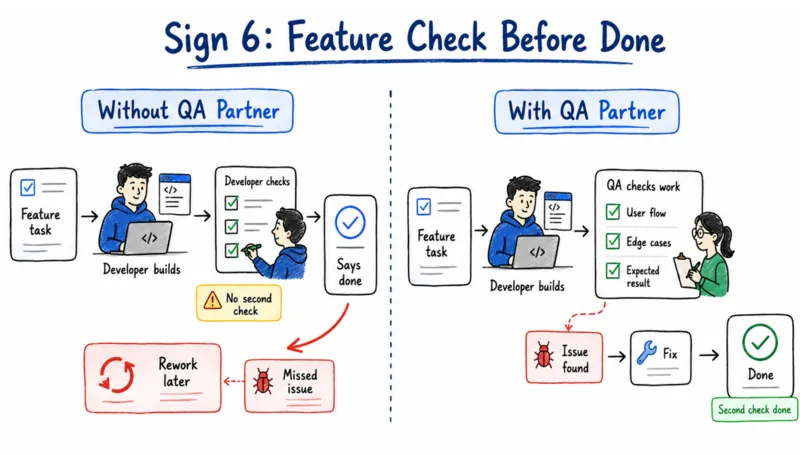
When the independent skeptic is absent, "done" means the developer thinks it works, which is not the same standard as an independent reviewer confirming it works against user expectations. DORA 2025 introduced Rework Rate specifically because AI-assisted teams were producing this pattern at scale. But your CI logs will never show it.
How to find this sign: Review your current Definition of Done and check if any criterion requires confirmation from a person who did not build the feature. If the developer who wrote the code can check every DoD item themselves, your DoD is developer confidence.
Pull your rework rate over the last quarter. The gap between what developers shipped as "done" and what required follow-up work is what the missing criterion costs per sprint.
How ThinkSys handles this
We rewrite your Definition of Done to include at least one criterion that structurally requires a non-builder to confirm independent validation against documented user expectations, not just "tests pass." We build the verification checklist, define who confirms it, and wire it into your existing sprint ceremony so it adds a gate, not a meeting. The goal is a "done" that means confirmed done by someone with no stake in it working - the standard your CI can't enforce and your builders can't self-certify.
Sign 7: Your team has no way to tell whether quality is improving or declining
Most engineering teams track deployment frequency, sprint velocity, and uptime. Almost no one tracks defect escape rate, rework rate per sprint, or time-to-first-incident after a release. The data exists. Yet no one is collecting it.
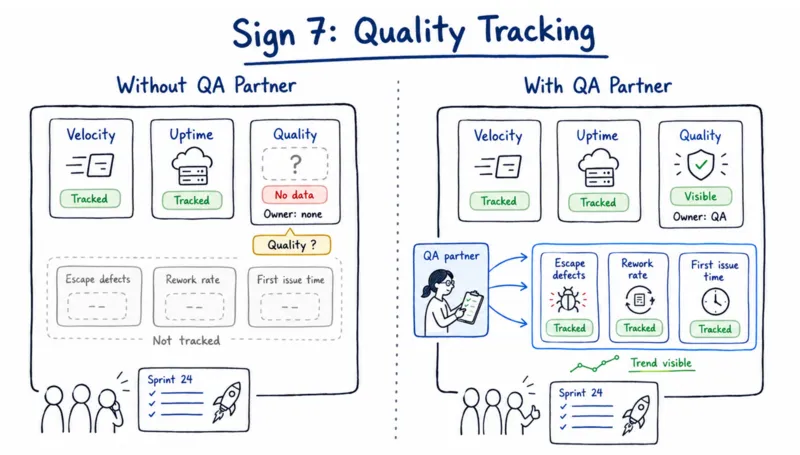
Velocity metrics exist because developers own velocity. Uptime metrics exist because infrastructure teams own uptime. Quality metrics are absent because no one owns quality. The missing measurement is itself the sign.
Without a baseline, your team cannot tell whether quality is improving or declining from sprint to sprint. You may be shipping faster while accumulating quality debt that surfaces as a support crisis six months from now. Or you may be genuinely getting better. Without the numbers, there is no way to know, and no way to make the case for investment in either direction.
How to find this sign: Pull your last six months of sprint data and answer - Is your defect escape rate trending up or down? Is rework rate per sprint increasing or decreasing? How long do new releases run before the first customer-reported issue? If you can't answer any of these, quality is invisible in your organization.
How ThinkSys Approaches This
The first thing we establish when we partner with a team is a quality baseline using three numbers:
- Defect escape rate over the last 90 days (what percentage of defects are found by customers rather than caught before release)
- Rework rate per sprint (how much sprint capacity goes to fixing what was already shipped as done)
- Time-to-first-incident after a new release (how long before a new deployment produces a customer-reported issue)
These three numbers tell us whether quality is trending in the right direction and give both teams a shared measure of what improvement actually looks like.
Proof point: Centerbase had no quality baseline when we started. After establishing one and realigning coverage: regression time down 30%, production bugs down 90% (15-20/release to 1-2), and $100K+ saved annually numbers they previously couldn't have produced on demand.
Score Your Team: How Many Signs Apply?
Total your "yes" answers across the seven diagnostics:
| Score | What It Means | What To Do |
| 0–2 signs | Healthy structure for your stage. Monitor as AI adoption scales. | Re-run this diagnostic quarterly. |
| 3–4 signs | Accumulating quality debt. It's invisible now and surfaces as a support crisis in ~6 months. | Establish a quality baseline this quarter; identify a governance owner. |
| 5–7 signs | Structural QA gap costing you 1–2 engineers' sprint capacity every month right now. | Bring in independent QA ownership before your next release cycle. |
Most AI-assisted teams in the 10–40 developer range score 3–5. The score isn't a verdict on your engineers, it's a measure of whether the function of independent quality exists in your org structure.
Get the Scorecard PDF + Benchmark Your Score Against Similar Teams
What Each Path Forward Costs
Taken together, the seven signs have a high cost. For a team of 20 to 40 engineers, the rework from escaped defects typically consumes the equivalent of one to two engineers' sprint capacity every month. Layer on top of that an ungoverned AI test suite with no strategy owner, automation with no sprint allocation, and no quality baseline to tell whether things are improving or getting worse. Your engineers feel it every sprint.
| Full-Time QA Hire | Dedicated QA Partner (ThinkSys) | |
| Cost | ~1 senior engineer salary, fully loaded | Typically 40-60% below a loaded US hire |
| Time to impact | 6-12 months to meaningfully change the pipeline | Independent coverage from sprint one |
| Coverage on day one | None | Immediate regression coverage + automation capability |
| Turnover risk | Industry QA tenure is short; backfill resets the ramp | No ramp reset, the partner team persists |
| Automation depth | Depends entirely on the single hire | Bench of automation specialists, not one person |
What ThinkSys addresses from day one:
- Quality baseline: defect escape rate, rework rate per sprint, and time-to-first-incident (the three numbers most teams cannot answer)
- Regression strategy: a prioritization protocol that governs AI-generated tests before more volume gets added
- Automation ownership: a dedicated sprint allocation and named owner so automation has a structural home
- Hold protocol: a named role with explicit block authority in the release authorization path
- External DoD standard: criteria that require a non-builder to confirm before a story ships
Conclusion
Staying as you are means that one to two engineers' worth of sprint capacity keeps going to rework, and the load grows as AI adoption accelerates. Without an independent feedback layer, the rework rises every sprint.
A full-time QA hire costs roughly what a senior engineer costs to carry, takes the better part of a year before they meaningfully change the pipeline, and statistically will leave within eighteen months. By the time they are fully contributing, you have spent two years of senior engineering budget with no coverage on day one and no guarantee of automation depth.
A dedicated QA partner brings immediate regression coverage and automation capability, without the ramp period or turnover risk. ThinkSys works with mid-sized SaaS teams at this layer to bring independent QA ownership from sprint one, inside the release cadence your team already runs.
Run the seven diagnostics above before your next sprint planning cycle. If you would rather have an independent team run them for you, schedule a call with ThinkSys QA experts.
Schedule Your Free 7-Sign QA Diagnostic