
Free Webinar, Oct 27Stop your AI agents from writing flaky playwright tests.
Free Webinar, Oct 27Stop your AI agents from writing flaky playwright tests.
Industry: AI Interpretation Platform / Communication Software | Stack: Playwright, TypeScript, GitHub Copilot, Cursor, CI/CD Sharding
TL;DR
Boostlingo -an AI-powered interpretation platform serving healthcare, legal, and enterprise customers in 300+ languages was losing 5–7 days per release to manual QA across 1,200 test cases. Their existing WebdriverIO automation was rigid, real-time audio/video flows couldn't be tested reliably, and the QA team was the release bottleneck. ThinkSys migrated them to Playwright + TypeScript, automated real-time AV testing using fake media streams + WebRTC mocking, used GitHub Copilot and Cursor to accelerate script development, and implemented test sharding.
Result: QA cycle time dropped 90% (from 5-7 days to 2 hours), coverage expanded from ~70% to ~100% across roles, script maintenance reduced 25%, and release frequency shifted from weekly to multiple deploys per week.

| Metric | Before | After | Improvement |
|---|---|---|---|
| QA cycle time per release | 5-7 days (manual) | ~2 hours (automated) | 90% reduction |
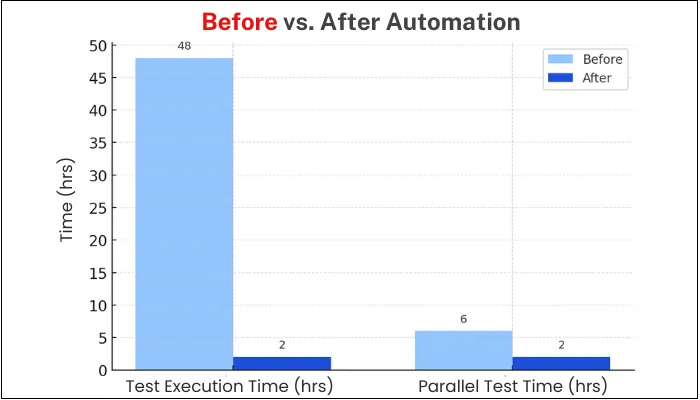
| Test execution time (full suite) | 6 hours sequential | ~2 hours with sharding | 67% faster |
| Test coverage across roles and flows | ~70% | ~100% | +30 percentage points |
| Script maintenance effort | Baseline | 25% reduction | Via modular architecture + AI assist |
| Release frequency | Weekly | Multiple per week | 3-4× more deploys |
| Real-time AV flow testing | Manual only (unreliable) | Fully automated | Previously untestable now covered |
Boostlingo is a unified language access platform delivering on-demand interpretation, multilingual event support, and AI-powered captioning across 300+ languages. Their customers include healthcare systems, legal teams, and enterprises that need to provide inclusive communication globally.
At the time of this engagement:
Their product was helping the world communicate faster, but internal QA workflows were the bottleneck holding them back.
Every release required 5-7 full days of manual testing across 1,200 test cases. The QA team had to validate dozens of user role combinations (interpreter + admin, supervisor + requester, etc.) which drained time and delayed delivery.
Because manual testing took so long, the team had to skip edge cases and less-common workflows. Real-time features: live interpretation calls, multilingual captioning, conference modes often went untested, raising the risk of bugs reaching production where they affected interpretation sessions in real customer scenarios.
Boostlingo had existing automation built on WebdriverIO, but the scripts were rigid, hard to maintain, and didn't adapt well to product changes. Each UI refactor broke significant portions of the test suite, and updates required hours of selector remediation per sprint.
Boostlingo's core value - real-time interpretation calls relied on WebRTC audio and video flows. Mic and camera access made these scenarios extremely difficult to automate against real hardware, and manual testing of AV quality was inconsistent and time-consuming. This created the worst possible situation: the most business-critical features had the lowest test coverage.
Engineering capacity was growing. QA headcount wasn't. The release process became a structural bottleneck, and the company began to ship slower than the market demanded.
After a one-week diagnostic of Boostlingo's existing automation, test architecture, and release process, ThinkSys proposed a five-part solution:
Why Playwright over Cypress, Selenium, or staying with WebdriverIO:
Reusable Page Object Models, helper functions, fixture-based authentication, and role-based test data factories. New roles or workflows can be added without rewriting existing tests. We built linting standards, folder-level organization, and structured logging from day one to prevent technical debt accumulation.
The hardest engineering problem in this engagement. Our approach:
--use-fake-ui-for-media-stream and --use-fake-device-for-media-stream flags to bypass real hardware--use-file-for-fake-audio-capture and --use-file-for-fake-video-captureResult: Real-time call flows that were 100% manual-only became fully automated and run on every PR.
We integrated GitHub Copilot and Cursor into the development workflow to accelerate test script creation:
Every AI-generated line was reviewed by our QA engineers before commit. Net effect: 25% reduction in script development time without quality compromise.
We implemented test sharding, running the suite across multiple worker threads in parallel to drop full-suite execution from 6 hours to ~2 hours. Tests were redesigned to be fully isolated and stateless so they could run in parallel without state pollution. Integrated into Boostlingo's CI/CD pipeline for real-time PR feedback.
We started by replacing the legacy WebdriverIO setup with Playwright and TypeScript. The migration prioritized script readability, modular structure, and long-term maintainability.
Feature parity was the biggest risk. We couldn't lose any existing coverage during translation. Our approach: audit all 1,200 WebdriverIO test cases, classify by business priority (P0-P3), migrate P0/P1 first with parallel validation against the existing suite, then sunset WebdriverIO module by module.
Real complication: Approximately 8% of the original WebdriverIO tests were actually broken or testing the wrong thing, they passed but didn't validate what they claimed. We surfaced these during translation and rebuilt them properly rather than carrying the bugs forward.
We built a scalable architecture supporting Boostlingo's growing role matrix and workflow complexity:
Goal: any QA engineer (junior or senior) could understand how tests were built, maintained, and extended within a few hours of onboarding.
The biggest engineering challenge in the project. Real-time AV flows required mic and camera access, typically a blocker for automation.
Our technical approach:
--use-fake-device-for-media-stream and --use-fake-ui-for-media-stream to bypass real hardware and permissions dialogs--use-file-for-fake-audio-capture=/path/to/test.wav and --use-file-for-fake-video-capture=/path/to/test.y4mpage.evaluate() to inspect RTCPeerConnection state and validate ICE candidate negotiationReal complication: WebKit doesn't support the same fake media flags as Chromium. We built a separate test path for Safari that uses Playwright's context.grantPermissions(['camera', 'microphone']) with placeholder streams.
Outcome: previously untestable real-time call flows now run automatically on every PR across Chrome, Firefox, and Safari.
We integrated GitHub Copilot and Cursor into the daily development workflow:
Every AI-generated suggestion was reviewed by a ThinkSys QA engineer before commit. The combination of AI acceleration + human review delivered 25% time savings on script development without quality regression.
The final optimization. Sequential execution of the full 1,200-test suite took 6 hours. We implemented Playwright's native sharding to distribute execution across multiple parallel workers:
Result: full suite execution dropped from 6 hours to under 2 hours. Boostlingo's developers now get PR-level test feedback before they finish their next task.
What once took 5-7 days of manual effort now takes approximately 2 hours of automated execution. The QA team reallocated saved time to exploratory testing on edge cases and new feature validation, moving from execution bottleneck to strategic quality oversight.
Automated scripts now handle edge cases, real-time call flows, and all user role combinations coverage areas that were previously skipped because manual testing didn't have time. Boostlingo's most business-critical features (real-time interpretation calls) went from lowest to highest coverage.
Playwright + TypeScript + modular architecture improved test stability dramatically. AI-assisted coding cut new script creation time by 25%. The team can now add coverage for new features in days, not weeks.
With faster and more complete test runs, Boostlingo now pushes features multiple times per week instead of weekly without cutting corners or risking production bugs. Time-to-customer for new features dropped meaningfully.
Test sharding optimized the full automation suite from 6 hours to under 2 hours, without any failure increase. This level of optimization saves significant QA engineering hours per release and reduces CI infrastructure cost.
"I honestly did not know what to expect. This is very inspiring. Great job.
The Playwright migration alone transformed how our team thinks about quality. We went from dreading release weeks to deploying multiple times per week with full confidence. The AV automation work, that's something I would have said was impossible six months ago."
- Jake Orona, Senior QA Lead Engineer, Boostlingo
If Boostlingo stopped working with us tomorrow, every test, every helper, every page object remains in their repository. Any Playwright-experienced engineer can take over.
Not always. We've helped clients stay on their existing framework when the migration cost outweighed the benefit. We've also helped clients migrate when their existing framework couldn't support their growth. Our diagnostic phase determines which applies to you, we tell you honestly, even when it means we don't get the migration work.
The Boostlingo engagement took approximately 4 months from kickoff to full production. Timeline depends on test suite size (Boostlingo: 1,200 cases), complexity (real-time AV added significant work), and team availability for parallel validation. Most migrations land in the 3-6 month range.
Yes. The combination of Chromium fake media flags, WebRTC signaling mocks, and Playwright's network interception lets us deterministically test call setup, audio stream presence, video codec negotiation, and call state transitions. The approach works across Chrome, Firefox, and WebKit/Safari with browser-specific paths where needed.
Engagements similar to Boostlingo's typically range $120K–$280K depending on scope, test suite size, and CI integration complexity. We start with a 1-2 week paid diagnostic that delivers a current-state audit, migration approach, and fixed-bid quote. If you don't proceed, you keep the audit.
Yes. All test code, Page Object Models, helpers, fixtures, documentation, and CI configuration live in your repository from day one. No proprietary ThinkSys platforms. No required ongoing services. If you end the engagement, everything stays with you.
Yes, as of 2025. We deliver measurable productivity gains (typically 20-30% on script development) without quality regression. Every AI-generated suggestion is reviewed by a ThinkSys QA engineer before commit. Clients with strict policy constraints on AI tooling can opt out.
The patterns we built for Boostlingo work for any WebRTC-based platform: video conferencing, telehealth, live streaming, virtual classrooms. We've reused the AV automation approach for 3 other clients across telemedicine and EdTech.
Boostlingo's story is what happens when a QA function moves from execution bottleneck to strategic quality oversight. By migrating to Playwright, automating previously untestable real-time AV flows, leveraging AI for development speed, and parallelizing execution, they went from weekly releases dragged down by 5-7 day QA cycles to multiple-per-week deploys with confidence.
If you're stuck in similar territory, slow release cycles, limited coverage on critical features, outdated automation tools, the path forward is rarely "add more QA headcount." It's usually a focused automation engineering investment that pays back in months, not years.
Phase 2 is in active scoping:
We continue working with the Boostlingo team on a quarterly engagement cadence.

About the Author
Gaurav Joshi
I am a QA Project Lead with expertise in QA leadership, test strategy, quality governance, Agile project delivery, defect management, and continuous process improvement, ensuring the successful delivery of high-quality software solutions.


