
Free Webinar, Oct 27Stop your AI agents from writing flaky playwright tests.
Free Webinar, Oct 27Stop your AI agents from writing flaky playwright tests.
Is Playwright MCP safe for enterprise use?
Yes, under governance. Playwright MCP gives an AI agent control of a real browser, which creates four specific risks: prompt injection from page content, over-broad session access, unintended agent actions, and data reaching your AI provider's context. All four are containable with boundaries you enforce at the environment level: non-production only, synthetic data, human review of all output, and MCP kept out of CI. Microsoft's own documentation is explicit that the tool is not a security boundary, your governance is.
That's the answer. The rest of this guide is the substance behind it: each risk's mechanism and containment, the governance framework as implementable policy, what changes for FinTech and Healthcare, a hardened configuration you can copy, and the five questions your security team will ask with the answers written down.
If you're new to the tool itself, start with our explainer on what Playwright MCP is and how it works. This guide assumes you know the basics and are deciding whether, and how to let it into an enterprise environment.
When your security team reviews a typical QA tool, they're assessing familiar things: dependencies, data handling, access permissions. Static, reviewable, predictable.
Playwright MCP breaks that model in one specific way: the instructions that drive it are interpreted at runtime by an AI, and some of those instructions can come from the web pages it visits.
That sentence is the entire threat model. A traditional Playwright test executes exactly the code your engineers wrote and reviewed. An MCP session executes whatever the AI decides is the right way to fulfill a natural-language goal, and the AI makes that decision while reading page content that you don't control.
This isn't a flaw in Microsoft's implementation. It's inherent to what the tool does, the same way "a car can crash" is inherent to what a car does. Cars are still useful; we added seatbelts, lanes, and licenses. This guide is the seatbelts, lanes, and licenses.
Security guides for AI tools tend to be either dismissive ("just don't use production data!") or apocalyptic. Here's the sober version, four risks, each with its mechanism and its containment.
The mechanism: The agent reads page content to decide what to do. That means page content can talk to the agent. A malicious or compromised page can embed text; visible or hidden, that reads like instructions: attempt to redirect the agent, extract session data, or trigger actions the operator never asked for.
This isn't hypothetical. Indirect prompt injection is LLM01 in the OWASP Top 10 for LLM Applications the top-ranked risk category, and security researchers have publicly demonstrated injection attacks against browser-using agents, including hidden page elements that redirect agents to attacker-chosen actions. Browser agents are the most natural target for this class of attack because reading untrusted content is their whole job.
Why QA teams underestimate it: "We only test our own app." True - until the agent follows a link off-site, loads a page with third-party content (ads, embedded widgets, user-generated content), or tests a feature that renders data submitted by users. Any text the agent can read is a potential instruction channel, including your own app's user-generated content.
Containment:
The mechanism: The MCP browser is a real browser. If it holds an authenticated session especially a production session, especially an admin one; the agent acts with that session's full authority. An agent with your admin cookie is an admin, and it's an admin that can be socially engineered by a web page (see Risk 1).
Containment:
The mechanism: Natural language is ambiguous; the agent resolves ambiguity with judgment you didn't review in advance. "Clean up the test records" can mean something very different to the model than it meant to the engineer who typed it. In a real environment, an agent's confident misreading clicks real buttons.
Containment:
The mechanism: Everything the agent reads i.e. page content, form values, whatever appears in the accessibility tree becomes part of the conversation with the AI model. If the browser can see real customer data, that data is now in your model provider's context, subject to whatever retention and training terms your AI contract specifies.
Why this is a compliance issue, not just a security one: For a HIPAA-covered entity, patient data in an MCP session's context is a disclosure question. For any company under GDPR, it's a processing question. Under PCI DSS, cardholder data reaching an unassessed third party is a scoping question. The tool didn't "leak" anything, you pointed it at data it faithfully read.
Containment:
Governance rules need a config that expresses them. Here's a starting point for an authoring workstation, verified against the current @playwright/mcp options:
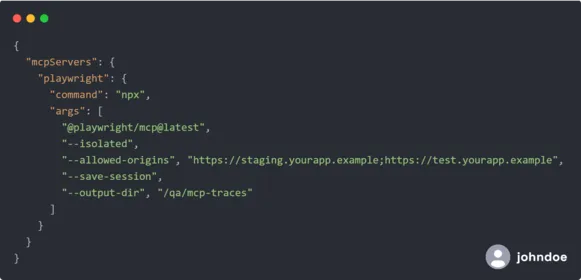
What each choice does:
| Option | Purpose | Honest limits |
|---|---|---|
| --isolated | Fresh in-memory profile per session; nothing persists, nothing leaks from personal profiles | State you want (test login) must be injected via --storage-state |
| --allowed-origins (semicolon-separated) | Pins browsing to the environments under test | Guardrail, not boundary; doesn't affect redirects; pair with network segmentation |
| --save-session + --output-dir | Session traces routed to a retained location, your replay/audit trail | Someone must own and review the location |
| Headed (default) | Engineer watches the agent during authoring | Not enforcement - a control that depends on the human actually watching |
Note: Two additions for enterprise scale:
Our MCP vs CLI guide states the five governance rules. Here's how each becomes something implementable; the difference between advice and policy is that policy names an owner, a mechanism, and a check.
| Rule | Mechanism | Owner | Verified by |
|---|---|---|---|
| Non-production only | Origin allowlists in MCP config; network segmentation blocks prod from dev machines running MCP | QA lead | Config review, quarterly |
| Scoped credentials | Dedicated test accounts, synthetic data, rotated like any credential | QA lead + IT | Access audit |
| Authoring tool, not CI runtime | MCP absent from CI images and pipeline configs; only npx playwright test runs in CI | DevOps | Pipeline config review |
| Human review gate | AI-drafted tests enter via pull request; review checklist covers selectors, assertions, isolation | Reviewing engineer | PR history |
| Page content is untrusted | Origin scoping + no sensitive sessions + injection awareness in team training | Every operator | Onboarding + spot checks |
Note: Two additions for enterprise scale:
Security teams think in when, not if. If you suspect an injection attempt succeeded or an agent acted outside intent:
Write these five steps into the same one-pager as the governance rules. An incident plan that exists before the incident is the difference between a postmortem and a panic.
This section decides adoption for regulated teams, so it deserves precision.
Auditors accept evidence that is reproducible and reviewable: this versioned test, against this build, produced this result, with this trace. The CLI test runner produces exactly that, version-controlled specs, deterministic runs, traces and videos on failure. It's why a well-run Playwright suite is itself a compliance asset, whether the framework in question is SOC 2, PCI DSS, or an FDA-adjacent quality system.
An MCP session is neither reproducible nor pre-reviewable. The same instruction can produce a different action sequence tomorrow; the "test logic" existed transiently in a model's context rather than in reviewable code. That's not a criticism, it's the flexibility that makes MCP useful for exploration. But it means MCP-driven runs cannot serve as controlled test evidence, and teams that try to present them as such create audit findings, not efficiencies.
The clean division: MCP accelerates the creation of your controlled evidence (drafting the tests). The CLI produces the evidence (running them, versioned and traced). Your audit story never needs to mention MCP at all, it lives entirely upstream of the record.
For financial platforms, three specifics sharpen the general rules:
For healthcare SaaS and covered entities, the single organizing question: can the MCP browser ever render PHI? If yes, that session's content enters model context, and you're in disclosure-analysis territory. The goal is making the answer structurally "no":
Handled this way, MCP accelerates test authoring for EHR-adjacent workflows without ever entering PHI's blast radius. Handled casually, it's a reportable event waiting for a trigger.
The fastest MCP approvals we've seen happened when QA arrived with these answered in writing. The slowest happened when infosec discovered the tool already installed.
Five questions, five answers, one page. That document is usually the difference between a two-week approval and a two-quarter one.
Security-safe adoption follows the same staged model we use for MCP generally, the maturity model from our Playwright MCP guide with security gates between stages:
Teams that skip to stage 3 don't usually get breached, they get discovered, by a security team that then freezes all AI tooling for six months. The staged path is slower by weeks and faster by quarters.
Playwright MCP's security story is neither scary nor trivial. The tool gives an AI a real browser; a real browser is real capability; real capability needs the same boring, effective governance we apply to every powerful tool: scope what it can reach, control what it can log into, review what it produces, keep it out of the release path, and write the rules down.
Do that, and MCP is an authoring accelerant your security team signed off on. Skip it, and you're not running an AI program, you're running an incident postmortem on a delay timer.
ThinkSys builds Playwright automation practices with this governance built in from day one; deterministic CLI foundation, synthetic test data, and an MCP rollout your infosec team approves in writing.
About the Author
Gaurav Mehta
Experienced Certified Scrum Master and QA Lead with 12+ years of expertise in Agile delivery, software quality assurance, team leadership, and stakeholder management. Guiding cross-functional Scrum teams through planning, execution, and continuous improvement while ensuring the delivery of high-quality software solutions. Passionate about fostering Agile best practices and leveraging Artificial Intelligence in software testing to optimize processes, enhance productivity, and improve software quality.


