
Free Webinar, Oct 27Stop your AI agents from writing flaky playwright tests.
Free Webinar, Oct 27Stop your AI agents from writing flaky playwright tests.
Recruiting a QA engineer takes 3-6 months. Your regression backlog doesn’t wait that long.
ThinkSys deploys a named, stable QA squad, a senior QA lead plus vetted Engineers directly into your sprints in 7 business days. Same people, sprint after sprint. Your tools, your repo, your workflows. Weekly KPI reporting, SLA-backed response times, and a release sign-off report before every deployment.
What is a dedicated QA team?
A dedicated QA team is a fixed group of named QA engineers, led by a QA lead, that embeds in your development sprints as an extension of your engineering organization, same people every sprint, working in your tools and repo. It differs from staff augmentation (individual contractors you manage) and managed testing (fully outsourced QA ownership): with a dedicated team, strategy is collaborative, execution is theirs, and product knowledge compounds over time.
The math first: A fully-loaded senior QA hire in the US runs $150,000-$190,000 a year, and takes 3-6 months to recruit and ramp. A dedicated 3-person ThinkSys squad (QA lead + automation engineer + manual QA) is typically comparable to the fully-loaded cost of 1-1.5 senior hires, starts in days, and covers three skill sets no single hire has.
A QA lead is included, and you interview them first: Every team ships with a senior QA lead who owns test strategy, runs your triage, and joins your ceremonies. Before any contract, you interview the actual lead assigned to your account. If they’re not right, we propose another. You’re hiring people, and you meet them like people.
Named engineers, contractually stable: The same testers, sprint after sprint, building product knowledge that compounds. Team-continuity clauses in every contract: if a member leaves, we guarantee documented knowledge transfer and a ramped replacement with no coverage gap.
Your tools, your repo, your IP. Test plans, automation frameworks, and defect insights live in your Jira, your GitHub, your dashboards from day one. NDA before any discussion. If we part ways, everything stays with you, including a documented handover.
Where the team sits. Our dedicated QA engineers work from ThinkSys delivery centers with guaranteed daily overlap with US time zones; QA leads hold ceremony availability in your working hours. That’s why the price works, and we’d rather you know it on the page than discover it on the call. Overlap hours, ceremony attendance, and response SLAs are written into the engagement.
A good fit if:
The wrong tool if:
We’ll tell you which in a 20-minute fit call, including when the answer is “not us yet.”
| Team | 1 QA Lead · 1 Automation Engineer · 1 Manual QA. |
| Start | 3-5 days; stable coverage in 2 weeks. |
| Stack | Jira, Playwright/Cypress, GitHub Actions, Allure. |
The QA lead embeds in sprint planning and reviews acceptance criteria before dev starts. The automation engineer builds tests that run on every commit, catching regressions in 15-30 minutes. Manual QA covers exploratory testing and the edge cases automation misses. You ship weekly without quality erosion.
| Team | 1 QA Lead · 2 Automation Engineers · 2 Manual QA · specialists per module. |
| Start | 5-7 days; module-by-module coverage buildout over 4-6 weeks. |
| Stack | Jira/Azure DevOps, Selenium or Playwright, Jenkins/Azure Pipelines, API test suite (REST-Assured/Postman). |
Enterprise products fail at the seams - integrations between modules, shared services, and cross-team dependencies. This blueprint assigns coverage ownership per module while the QA lead maintains an integration-risk map across them. Regression is layered: fast smoke per module on every build, full cross-module regression on release candidates. Documentation is built for audit and handover from day one, because enterprise engagements outlive individual roadmaps.
| Team | 1 QA Lead · 1 Mobile Automation Engineer (Appium) · 1 Manual QA with device-lab expertise. |
| Start | 3–5 days; device matrix agreed in week one. |
| Stack | Appium, Espresso/XCUITest, BrowserStack/Sauce Labs real-device cloud, Play Console + App Store Connect. |
Mobile QA is device-matrix strategy plus store-readiness discipline. We build your matrix from your user analytics (not a generic device list), automate the stable core flows on real devices, and manually test the OEM-specific behaviors that break apps in production - battery managers, background limits, permission flows. Release testing includes store-submission readiness: crash/ANR thresholds for Google Play, review-guideline checks for the App Store.
| Team | 1 QA Lead with regulated-industry experience · 1 Automation Engineer · 1 Manual QA · Security tester on-demand. |
| Start | 5–7 days (access provisioning under your security policies takes the extra days). |
| Stack | Your approved toolchain; test evidence managed for audit trail (test cases → execution records → sign-offs). |
In regulated environments, the test evidence is a deliverable. Every test run is traceable; requirement to test case to execution record to release sign-off, so audit requests are an export, not an archaeology project. Testing covers compliance-relevant flows (transaction integrity, PHI handling, audit logging) against masked or synthetic data only, with security testing (OWASP-aligned) scheduled per release or per quarter as your obligations require.
Not sure which blueprint fits? Tell us your release cadence and platforms, we’ll recommend a team composition within 24 hours.
Days 1–7: Start testing. Access, environments, and test data secured. Smoke suite executed manually across 10-15 critical workflows. Workflow aligned: Jira, Slack, CI triggers, standup schedule, QA definition-of-done agreed. Output: first defects logged, smoke suite documented, communication cadence running.
Days 8–30: Build coverage. The regression suite takes shape: critical paths documented and executed every sprint, defect triage cadence established, automation framework stood up and first high-value tests running in your CI. The team’s product knowledge starts compounding, questions get sharper, edge cases get caught earlier. Output: documented regression suite, automation framework live, first weekly KPI baselines.
Days 31–60: Predictability. Automation coverage expands across stable flows; flaky tests get diagnosed and stabilized before scaling further. Release sign-offs become routine: every deployment gets its 2-hour readiness report. KPI trends now have enough history to act on defect density hotspots identified, recurring root causes reported. Output: releases with data-backed go/no-go, automation pass rate stabilizing above 90%, defect leakage trending down.
Days 61–90: Optimization. Coverage-to-risk mapping is refined from two months of defect data. Automation ROI review: what’s paying for itself, what needs rework, what’s next. The team proposes process improvements from inside your workflow: spec clarity, environment stability, test-data management. Output: 90-day QA health report with quality trendlines and an improvement roadmap for the next quarter.
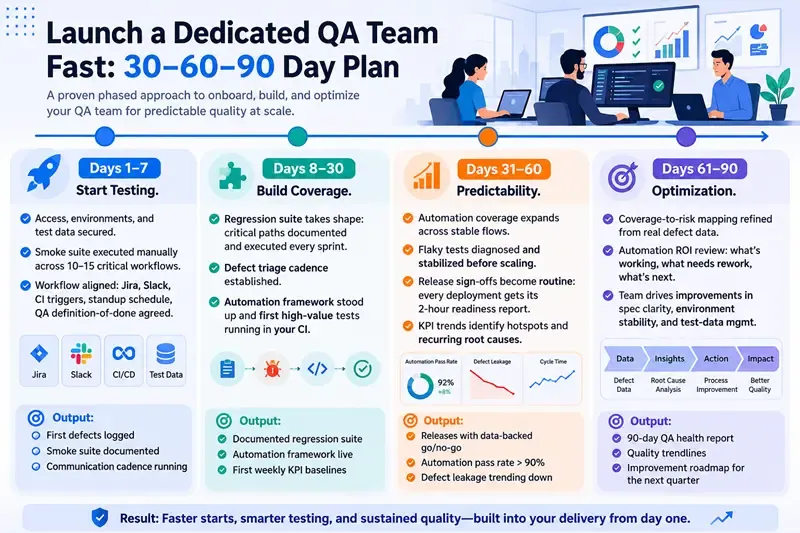
Cadence (adapts to yours): Daily 15-min standup · defect triage 2×/week · sprint planning and retro with your team · 20-min release sign-off per release · weekly KPI review Mondays.
| Commitment | SLA |
|---|---|
| New defect triage | Within 24 hours, severity assigned |
| Retest turnaround | Critical/High same day; Medium/Low next business day |
| Release report | Within 2 hours of final build |
| Blocker escalation | Within 1 hour (critical path only) |
| Daily status | End of day, in your Slack/Teams |
| Replacement on team change | Knowledge transfer + ramped replacement, no coverage gap |
Escalation path: tester → dev (standard defects) · QA lead → engineering lead (blockers, environments) · QA lead → product/CTO (release delays, critical risk).
Scaling: adjust team size with two weeks’ notice. Add specialists (performance, security, accessibility) per sprint without long-term commitment.
Twelve metrics, each with a target and a reason -summarized weekly, trended monthly. The five leadership cares about most:
| KPI | Target | Why it matters |
|---|---|---|
| Defect leakage | <5% of defects reach production. | The number that measures whether QA is working. |
| Automation pass rate | >90% consistently in CI. | Below that, teams stop trusting the suite. |
| Flaky test rate | <5%. | False alarms erode pipeline confidence. |
| Release readiness | 100% of critical/high tests executed pre-cutoff. | Enables data-backed go/no-go. |
| Time-to-verify | Critical/High fixes verified <24h. | Faster verification = faster releases. |
The other seven (reopen rate, execution trend, requirements-clarity blockers, defect density by module, recurring root causes, environment availability, sprint-velocity impact) appear on your weekly dashboard with the same target/trend treatment.
What it costs: a typical 3-person squad (QA lead + automation + manual) is typically comparable to the fully-loaded cost of 1–1.5 senior US QA hires for three people and three skill sets. Cost scales with team size and roles, platform count, release frequency, automation scope, compliance requirements, and device-lab needs.
Every quote includes: role breakdown, ramp timeline, 30/60/90 deliverables, cost structure, and stated assumptions, so you can compare it against hiring line-by-line.
SaaS Project Management Platform
| Dedicated QA team (this page) | Managed testing | Staff augmentation | |
|---|---|---|---|
| QA Strategy | Collaborative, your priorities, our QA lead. | ThinkSys owns it end-to-end. | Yours entirely. |
| Execution Management | Our embedded QA lead. | ThinkSys, against KPIs. | Your managers. |
| Best For | Ongoing product, embedded capacity, 6+ month roadmaps. | Handing QA off entirely with outcome accountability. | Short-term capacity you direct daily. |
| Speed to start | 3–7 days. | ~1–2 weeks (governance setup). | 1–3 days (individuals). |
| Knowledge retention | High - same named team. | High - documented under governance model. | Low - individuals rotate. |
Rule of thumb: want QA with you → dedicated team. Want QA done for you → managed testing. Want hands you manage → augmentation. Genuinely unsure? The 20-minute fit call exists to answer exactly this, and we’ll recommend a competitor model over a bad fit.
A dedicated QA team is a fixed group of named QA engineers, led by a QA lead, embedded in your development sprints as an extension of your engineering team, same people every sprint, working in your tools and repository. Strategy is collaborative, execution is theirs, and product knowledge compounds over time, unlike rotating contractors or fully outsourced models.
Most teams are live and testing within 3–7 business days: day one covers kickoff, tool access, and product walkthrough; first smoke testing and defect logging happen in week one. Stable automation coverage typically takes 2–4 weeks depending on product complexity.
Yes. You interview the actual QA lead assigned to your account before any contract. If they’re not the right fit, we propose another candidate.
Our delivery teams work from ThinkSys delivery centers with guaranteed daily overlap with US time zones; QA leads attend your ceremonies in your working hours. Overlap hours and response SLAs are written into the engagement.
A typical 3-person squad (QA lead, automation engineer, manual QA) runs on a fixed monthly retainer, usually comparable to the fully-loaded cost of one to one-and-a-half senior US QA hires, for three people and three skill sets. Cost scales with team size, platforms, release frequency, automation scope, and compliance needs.
Three months for dedicated teams, that’s the floor for the team to build enough product knowledge to deliver full value. Sprint-based engagements (4–12 weeks, fixed scope) exist for shorter needs.
Augmentation gives you individual contractors who report to your managers, you own strategy, execution management, and quality outcomes. A dedicated team arrives with its own QA lead who owns execution and reporting inside a collaborative strategy. It’s an embedded team, not rented individuals.
Everything is yours i.e. test plans, automation code, defect history, documentation, dashboards - because it lived in your repository all along. We deliver a documented handoff package; there is no vendor lock-in by design.
Yes, adjust team size with two weeks’ notice, and add specialists (performance, security, accessibility) per sprint without long-term commitment. If a team member leaves, a replacement is knowledge-transferred and ramped under the continuity clause in every contract.
Both, always. Every dedicated team includes automation capability (Playwright, Cypress, Selenium, or Appium to match your stack), building a suite that runs in your CI and grows sprint over sprint alongside manual and exploratory coverage.
SaaS, FinTech, healthcare, insurance, e-commerce, and enterprise software, including compliance-heavy environments (HIPAA, PCI-DSS, SOC 2 evidence requirements) and multi-platform products across web, iOS, Android, and APIs.
Book the 20-minute fit call. We’ll walk through your release cadence, team structure, and testing gaps, then recommend dedicated team, managed testing, or augmentation, including telling you when a lighter model fits better.
Hiring QA takes a quarter; renting rotating contractors wastes the product knowledge you paid for. A dedicated QA team is the middle path with the advantages of both: named engineers who compound knowledge like employees, deployed in days like a vendor, with SLAs and KPI accountability neither gives you. Interview the lead, check the math against a hire, and start with a sprint.

About the Author
Gaurav Joshi
I am a QA Project Lead with expertise in QA leadership, test strategy, quality governance, Agile project delivery, defect management, and continuous process improvement, ensuring the successful delivery of high-quality software solutions.


