How ThinkSys Transformed Tinder’s Test Automation Architecture for Faster, More Reliable QA
Summarize With:


Tinder’s test automation was becoming hard to manage. Tests failed often, regression cycles were slow, and remote execution had limits.
As testing grew across more features, devices, and workflows, the QA team needed a setup they could trust. It also had to be easier to maintain.
ThinkSys worked with Tinder to improve the automation step by step. The goal was to make testing more stable without disrupting the current QA process.
This case study explains the challenges Tinder faced, the approach ThinkSys used, how the new setup was tested, and the results it delivered.
Meet Tinder

Tinder is a global dating and social networking platform that helps people connect with others through its mobile and web applications. With millions of users and frequent product updates, the platform requires reliable testing across different features, devices, browsers, and user journeys.
As Tinder’s product and testing needs grew, its existing automation architecture began to create challenges for the QA team. The engagement focused on improving the reliability, scalability, and execution speed of the automation framework while preparing it for remote and parallel testing.
The Challenge
Tinder already had test automation in place, but several technical and operational problems limited its value.
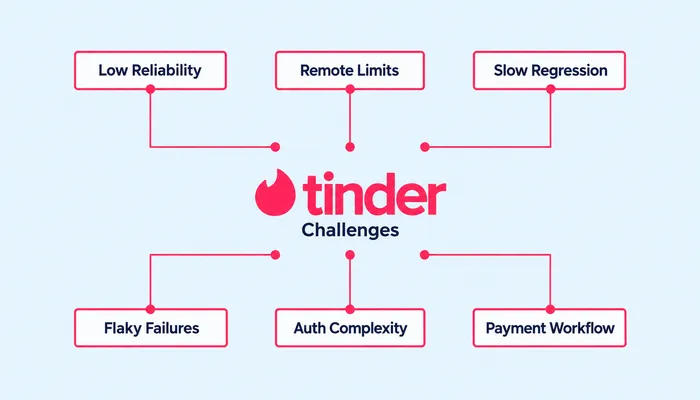
The main challenges included:
- Low automation reliability: Less than 40% of test executions completed successfully, creating low confidence in automated results.
- Frequent flaky failures: Tests could fail because of synchronization, locator, session, or workflow issues rather than actual product defects.
- Limited remote execution: The existing automation could not run effectively and consistently on BrowserStack.
- Slow regression cycles: Sequential execution increased the time required to complete larger test suites.
- High rerun effort: Failed tests often required reruns and manual investigation before teams could understand whether the application or the test itself had failed.
- Complex authentication workflows: Login, OTP, email verification, and session handling added time and instability to end-to-end tests.
- Payment workflow complexity: Payment scenarios needed a safe and repeatable testing approach without making automated runs fragile.
- Growing maintenance effort: As features, devices, and test scenarios increased, maintaining the existing automation became harder.
- Migration concerns: Tinder needed a better architecture without disrupting existing QA activities or losing current test coverage.
The challenge was therefore not simply to add more automated tests. The existing foundation first needed to become reliable, maintainable, and scalable.
The Proposed Solution
ThinkSys recommended a phased modernization strategy focused on stability first and scale second.
The approach included:
- Strengthening the automation foundation: Use stable locators such as IDs and data-testid attributes along with better synchronization and wait strategies.
- Improving framework design: Create reusable utilities, components, and workflow functions to reduce duplicate code and simplify maintenance.
- Optimizing complex workflows: Improve session handling and automate login, OTP, and email verification so these flows can complete quickly and consistently.
- Stabilizing payment testing: Use sandboxed payment workflows with retry handling where needed to reduce avoidable failures.
- Enabling parallel execution: Structure the framework to run tests simultaneously across BrowserStack devices and browsers.
- Preparing CI/CD execution: Integrate automation with GitHub Actions so tests could become part of the delivery pipeline.
- Organizing test suites: Separate Smoke, Critical, and Regression tests so teams could run the right level of coverage at each stage.
- Planning future AI-assisted improvements: Identify opportunities to use AI for faster failure analysis, code improvements, and edge-case discovery.
Rather than starting with a complete migration, ThinkSys used a workflow to validate the architecture against real end-to-end user journeys.
Results
The major improvement was in automation stability and execution speed. Test execution success increased from less than 40% to more than 95% for the validated workflows.
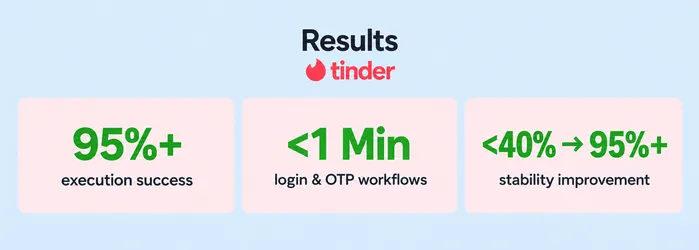
Complex authentication flows that previously took several minutes could be completed in seconds, with critical login and OTP workflows completing in under one minute.
Other outcomes included:
- More than 95% execution success: The validated workflows achieved an execution success rate above 95%, compared with less than 40% previously.
- Fewer test reruns: Improved synchronization, locators, and workflow stability reduced failures caused by automation issues and lowered the need for repeated test runs.
- Faster authentication workflows: Login, OTP, email verification, and session-based workflows were optimized to complete more quickly and consistently.
- Critical journeys completed in under one minute: Key end-to-end workflows, including login and OTP scenarios, were completed in less than one minute instead of taking several minutes.
- Parallel BrowserStack execution: The framework supported running tests simultaneously across BrowserStack devices and browsers, improving coverage and execution speed.
- Shorter regression cycles: Parallel execution reduced the dependency on sequential test runs and helped teams complete regression testing faster.
- Less manual failure investigation: More reliable test results reduced the time QA teams spent determining whether failures were caused by the application or the automation.
- Improved framework maintainability: Reusable components and shared workflows reduced duplicate code and made future updates easier to manage.
- Stronger CI/CD readiness: The automation structure was prepared for integration with GitHub Actions and other CI/CD workflows.
- Scalable test architecture: The framework could support additional features, browsers, devices, and test scenarios without creating the same level of maintenance complexity.
The improved architecture also allowed the QA team to spend less time maintaining unstable tests and more time expanding meaningful test coverage.
Implementation Steps
Step 1: Assessing and Stabilizing the Existing Automation
ThinkSys first reviewed Tinder’s existing automation framework to identify the main causes of low reliability, flaky failures, slow regression cycles, and limited BrowserStack support. The assessment covered locator strategies, synchronization, session handling, authentication workflows, test maintenance, and execution time. The team then strengthened the foundation by using reliable IDs or data-testid attributes and improving wait strategies so tests responded to application states instead of relying on fragile timing assumptions. This helped ensure that tests failed because of actual application issues rather than automation instability.
Step 2: Building Reusable Framework Components
After stabilizing the foundation, ThinkSys improved the framework by creating reusable utilities, components, and shared business workflows. Common actions were consolidated instead of being repeated across individual tests, reducing duplicate code and making updates easier. This improved consistency, lowered maintenance effort, and created a structure that could support additional test coverage without increasing complexity at the same rate.
Step 3: Optimizing Critical User Workflows
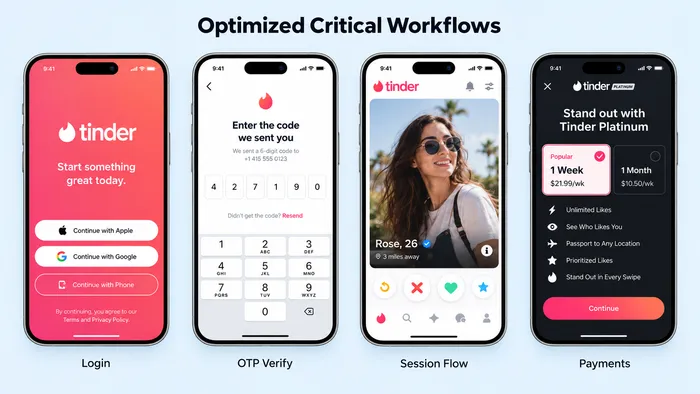
The workflows focused on improving important end-to-end journeys, including login, OTP and email verification, session handling, and payments. Smarter session management and optimized authentication flows reduced the time required for authentication-heavy scenarios from several minutes to seconds, with critical login and OTP journeys completing in under one minute. Payment workflows were validated through sandboxed environments, with appropriate retry handling to reduce failures caused by temporary or external conditions.
Step 4: Enabling Parallel BrowserStack Execution
ThinkSys structured the automation to support remote execution across BrowserStack devices and browsers. Parallel execution allowed multiple tests to run simultaneously instead of sequentially, helping reduce regression time and expand coverage. The process demonstrated that the architecture could support this execution model while maintaining more than 95% reliability for the validated workflows.
Step 5: Preparing Automation for CI/CD
To make execution more targeted and cost-efficient, the automation was organized into Smoke, Critical, and Regression suites. Smoke tests could provide fast feedback after changes, Critical tests could validate key business journeys, and Regression tests could provide broader coverage when required. The framework was also prepared for execution through GitHub Actions, allowing automation to become part of the CI/CD process.
Step 6: Validating the Approach Through a Tried and Tested Process
Rather than requiring Tinder to migrate its entire automation framework at once, ThinkSys validated the proposed architecture through a focused approach. The overall process covered login, OTP verification, email flows, session handling, payments, remote execution, and parallel testing. It achieved more than 95% execution success and showed that critical workflows could run significantly faster than before. This created a lower-risk path for gradual migration, allowing existing QA processes to continue while stable workflows moved to the improved architecture.
Conclusion
Tinder’s automation needed greater reliability, speed, and scalability, not more test cases.
ThinkSys improved the foundation, optimized critical end-to-end workflows, and enabled reliable parallel execution on BrowserStack. The workflow increased test execution success from less than 40% to more than 95% and reduced key authentication flows from minutes to seconds.
The phased approach allowed Tinder to modernize without disrupting existing QA processes, helping teams spend less time on reruns and maintenance and more time on meaningful testing.
If you want to improve your test automation, we provide a zero-critical-bug guarantee. Let’s schedule a call to discuss how we can help.
Facing similar challenges to Tinder?