
Free Webinar, Oct 27Stop your AI agents from writing flaky playwright tests.
Free Webinar, Oct 27Stop your AI agents from writing flaky playwright tests.
Industry: Venture Capital / Startup Accelerator | Stack: React, Node.js, PostgreSQL, HubSpot API, AWS
TL;DR
MuckerLab, a Southern California accelerator was burning 28 hours a week reconciling investor spreadsheets and tracking email conversations across 7 disconnected tools. They considered Affinity ($60K/year) but the rigid CRM model didn't fit their accelerator workflow. ThinkSys built a custom investor management platform in 12 weeks using React + PostgreSQL + HubSpot integration. Result: 14 hours/week saved, $182K projected annual savings, 100% email tracking automation, and a system that scales to institutional LPs. Total project investment: $94K. ROI: 7 months.
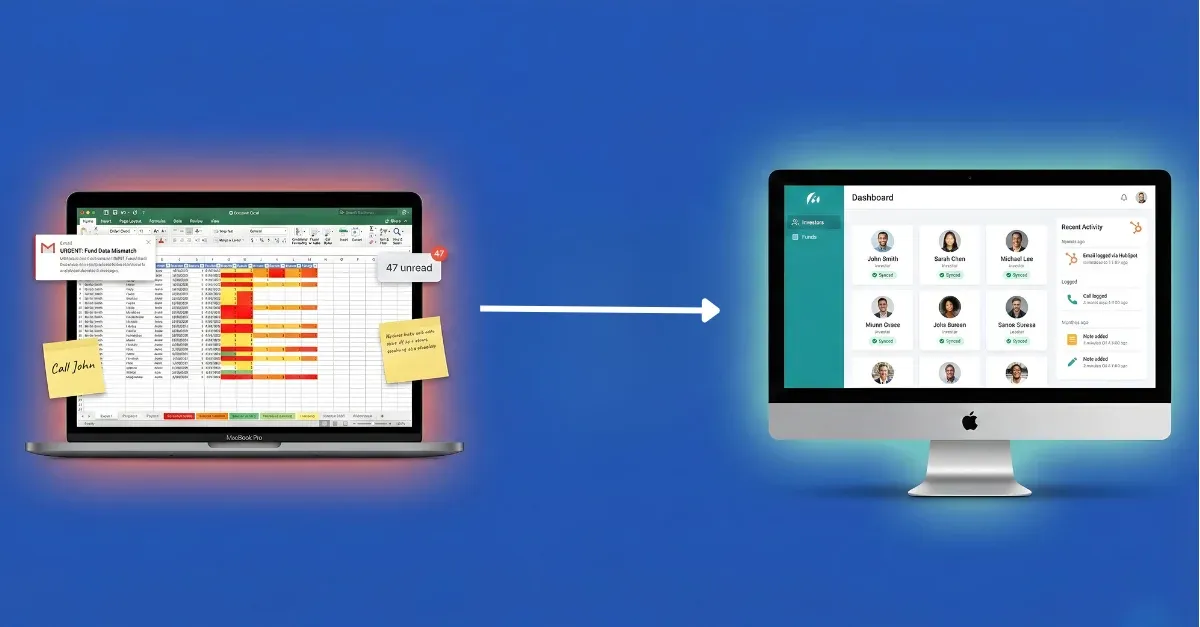
| Metric | Before | After | Improvement |
|---|---|---|---|
| Investor management hours per week | 28 hours | 14 hours | 50% reduction |
| Tools used for investor operations | 7 (Excel, Outlook, etc.) | 1 (custom platform) | 86% consolidation |
| Email tracking accuracy | ~60% (manual) | 100% (automated) | Full coverage |
| Time to find investor history | 8-12 minutes | Under 10 seconds | 98% faster |
| Annual cost savings | - | $182,000 | Payback in 7 months |
| Project duration | - | 12 weeks | On time, on budget |
MuckerLab is a mentorship-driven accelerator based in Santa Monica, California, founded in 2011. They invest in seed and early-stage internet, media, and SaaS startups, operating with a hands-on model where partners function as extensions of founding teams.
At the time of this engagement:
By 2023, their investor base had grown 4× in three years, but their tooling hadn't kept up.
Before ThinkSys, MuckerLab's operations team was losing roughly 28 hours per week, across 4 team members managing investor data and communication. Here's what was actually happening:
Investor data lived in:
Every time a partner asked "What did Investor X say about Fund III?" The operations team had to manually search 4–5 of these tools.
In early 2023, a $750K commitment from a returning LP was nearly missed because the email confirming it was buried in a junior team member's inbox, and the investor record in Excel hadn't been updated.
That incident triggered the search for a solution.
MuckerLab evaluated three obvious alternatives before talking to ThinkSys:
| Tool | Annual Cost | Why It Didn't Work |
|---|---|---|
| Affinity | $60,000 | Rigid CRM model; couldn't represent fund-investor relationships natively; required heavy customization that defeated the "out of the box" benefit |
| Visible | $24,000 | Excellent for LP reporting, but no support for ongoing investor sourcing and deal-flow context |
| Airtable + Zapier | $12,000 | Tried for 4 months; hit performance and permission limits at 180+ investor records; email integration was fragile |
The custom-build decision came down to one factor: MuckerLab's workflow had specific accelerator-model needs (fund-investor-portfolio-company relationships) that didn't fit any CRM built for sales or fundraising alone.
ThinkSys designed and built a web-based investor management platform with five core modules:
A relational data model where:
We integrated HubSpot's email tracking API with custom matching logic:
Result: Email tracking went from ~60% manual coverage to 100% automated.
The hardest engineering problem in the project. We built logic that:
This was where we spent the most engineering effort, and what makes the platform genuinely differentiated.
Instead of jumping between Excel → Outlook → DocuSign, the operations team now:
The system was designed to handle:
We embedded with MuckerLab for two weeks of discovery:
Real complication: Three investors had subscribed under multiple legal entity names. We had to build a fuzzy-matching deduplication tool before migration could begin. This added 4 days to the timeline.
Tech stack decisions and rationale:
First sprint delivered the investor profile page and fund record system. MuckerLab reviewed weekly demos starting week 3.
This was the highest-risk phase. We:
Real complication: Initial logic incorrectly matched forwarded emails to the wrong fund. We added a forwarded-message detector and sender-chain analyzer to fix it.
We migrated:
The MuckerLab team did parallel testing for 8 days, comparing the new system against their Excel files for accuracy.
We:
| Activity | Before (hrs/week) | After (hrs/week) | Saved |
|---|---|---|---|
| Investor data reconciliation | 12 | 2 | 10 |
| Email logging and tracking | 8 | 0 (automated) | 8 |
| Finding investor conversation history | 5 | 0.5 | 4.5 |
| Quarterly reporting prep | 3 | 1 | 2 |
| Total weekly hours saved | 28 | 3.5 | 14.0 |
Across the 4-person operations team, that's 14 hours of saved capacity per week, equivalent to bringing on a part-time analyst without the hire.
At a fully-loaded ops team cost of $130/hour (US fully-loaded):
Project investment: $94,000
Payback period: 7 months
3-year ROI: 581%
"We almost signed with Affinity. We were 48 hours from the contract. But we kept hitting the same problem in the demo, their data model just didn't represent how an accelerator works.
ThinkSys spent two weeks understanding our actual workflow before suggesting a custom build. The platform they delivered in 12 weeks does exactly what we need, and nothing we don't. The HubSpot email matching alone has paid for the project twice over.
We're already planning Phase 2 with them: institutional LP reporting and Carta integration."
-EriK Rannala, Co-Founder, MuckerLab
This is the question every custom software buyer asks. Here's the honest answer:
Translation: If MuckerLab stopped working with us tomorrow, the platform keeps running, their data stays theirs, and any competent engineer can pick up where we left off.
This is what an honest case study looks like:
We're not a generic dev shop. Three things make us specifically suited to this kind of build:
Engagements similar to MuckerLab's typically fall in these ranges:
| Engagement Type | Typical Range | Best For |
|---|---|---|
| Custom Operations Platform (like MuckerLab) | $75K-$150K | 8-14 week builds, 4-10 person teams |
| Workflow Automation Audit | $15K-$25K | Pre-build assessment, ROI modeling, build-vs-buy comparison |
| Ongoing Support Retainer | $1,400-$8,000/month | Post-launch maintenance, feature evolution |
We typically begin with a 2-week paid discovery ($18K) that delivers a workflow audit, architecture proposal, and fixed-bid project quote. If you don't proceed with the build, you keep the audit.
Sometimes yes. Our discovery phase determines whether your workflow needs are best served by extending an existing tool or building fresh. About 40% of our prospects end up NOT building custom, we tell them which off-the-shelf tool to use instead. That's not a sales tactic, that's honesty.
Fixed-bid contracts with milestone deliverables. If we miss a milestone, you don't pay for it. We've delivered every project in the operations-platform category on time for the last 3 years.
Three options: (1) hire a developer in-house -the code is yours, in your repo; (2) hire any agency - we hand off cleanly; (3) keep us on a maintenance retainer ($1,400/month). We don't force option 3.
The MuckerLab platform was built SOC 2 ready from day one: encryption at rest and in transit, role-based access controls, audit logging, AWS-native security. We bring a security checklist to every engagement involving sensitive data.
That's actually a great signal that you need our 2-week discovery before any build. We've helped multiple clients realize they didn't need custom software at all just better processes. We bill for the discovery whether you build or not.
Yes. Talk to 3 of our recent clients. We'll arrange the calls.
MuckerLab's story is unusual in one way: most companies looking at custom software should NOT build custom. Off-the-shelf tools are good enough for 70% of operations workflows.
The 30% where custom wins:
If that's you, we should talk.
Phase 2 is in scoping now:
We continue working with the MuckerLab team on a monthly cadence.

About the Author
Gaurav Mehta
Experienced Certified Scrum Master and QA Lead with 12+ years of expertise in Agile delivery, software quality assurance, team leadership, and stakeholder management. Guiding cross-functional Scrum teams through planning, execution, and continuous improvement while ensuring the delivery of high-quality software solutions. Passionate about fostering Agile best practices and leveraging Artificial Intelligence in software testing to optimize processes, enhance productivity, and improve software quality.


