
Free Webinar, Oct 27Stop your AI agents from writing flaky playwright tests.
Free Webinar, Oct 27Stop your AI agents from writing flaky playwright tests.
Clinical trial software · Selenium + Karate + Playwright → unified Playwright TypeScript
| Client | CRIO (Clinical Research IO) digital clinical trial software for sponsors, research sites, and CROs |
| Industry | Life sciences / clinical research technology (regulated) |
| Starting point | Three frameworks: Selenium (UI), Karate (API), Playwright (partial UI) |
| What we built | One Playwright TypeScript framework covering UI + API, with shared utilities, centralized config, and unified Allure reporting |
| Scope | 1,400+ test scripts migrated and reworked |
| Headline results |
|
Clinical Research IO (CRIO) builds digital clinical trial software used by sponsors, research sites, and contract research organizations worldwide. Their platform handles the workflows that clinical research runs on: study setup, data capture, source documentation, and the audit trails that come with all of it.
That last part matters for this story. In clinical research software, a defect isn't a UX complaint. It's a data integrity question, and data integrity is the product.
CRIO's automation had grown the way most do; one tool at a time, each solving the problem in front of it. Selenium for UI. Karate when API testing became a priority. Playwright when the team started modernizing. Each choice made sense on its own. Together they created five compounding issues:
The pattern underneath all five: the team wasn't slow because they lacked skill. They were slow because they were maintaining an architecture instead of using one.
Consolidation was the obvious move. Which framework to consolidate onto was the real decision, and it came down to three things:
The rest followed: shared cross-platform utilities and stronger locator strategies to kill the duplication, centralized configuration and one reporting dashboard for visibility, parallel execution for faster CI feedback, and documented standards so the framework stayed consistent after we left.
This is the part that matters most for a regulated platform, and it's the question every engineering leader asks: what happens to our release train while you're rebuilding the thing that gates it?
The answer was to never let the old suite go dark.
Once the framework was stable and validated, it went live through CRIO's CI/CD pipeline in a single deployment.
Clinical trial software carries obligations most SaaS products don't. Consolidating the framework was also an opportunity to make quality evidence easier to produce, not harder.
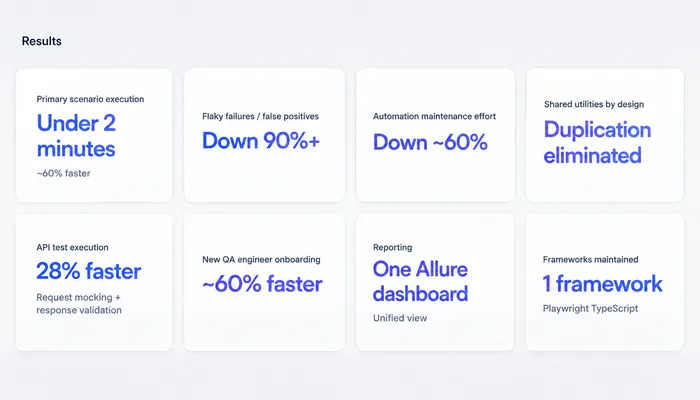
| Metric | Before ThinkSys | After ThinkSys |
| Primary scenario execution | ~5 minutes | Under 2 minutes (~60% faster) |
| Flaky failures / false positives | Recurring build failures; 40+ hrs/month investigating | Down 90%+ |
| Automation maintenance effort | Three frameworks maintained separately | Down ~60% |
| Duplicated code | ~35% across three repos | Shared utilities; duplication eliminated by design |
| API test execution | Karate, separate stack | 28% faster with Playwright request mocking + response validation |
| New QA engineer onboarding | Three setups, three conventions | ~60% faster ramp-up |
| Reporting | Scattered across systems; ~3-day avg resolution lag | One Allure dashboard, unified view |
| Frameworks maintained | 3 (Selenium, Karate, Playwright) | 1 (Playwright TypeScript) |
Three lessons that generalize beyond CRIO:
This is the same framework-first approach behind our Playwright automation practice, and the same discipline from our Selenium to Playwright migration work. If flaky tests are your starting problem rather than framework sprawl, start with how to reduce flaky tests.
CRIO didn't have a tooling problem. They had three tooling problems, plus the overhead of holding them together. Consolidating UI and API automation into one Playwright TypeScript framework cut primary scenario execution to under two minutes, removed the flaky failures that were burning 40+ hours a month, and made onboarding a matter of learning one system instead of three.
The framework that replaced them is the part that lasts: shared utilities, one reporting view, documented standards, and a foundation their team can extend without rebuilding.
Running separate frameworks for UI and API testing multiplies maintenance, duplicates utilities, splits reporting, and slows onboarding - engineers have to learn every stack before contributing. Consolidating onto one framework removes that overhead. In CRIO's case, moving from Selenium, Karate, and Playwright to a single Playwright TypeScript framework cut maintenance effort by roughly 60% and onboarding time by about the same.
Yes. Playwright's APIRequestContext handles REST API testing natively: request construction, response validation, and mocking, which lets UI and API automation share one framework, one language, and one reporting layer. The migration question to validate first is whether your existing API assertions can move over without losing depth; once that's confirmed, consolidation is viable.
Run both suites in parallel. Bridging tooling lets the legacy and new frameworks execute together in CI, so existing coverage keeps gating releases while the new suite proves itself. Retire the old framework in phases by test category, as each Playwright equivalent demonstrates it catches the same failures, rather than cutting over all at once.
Only if the destination framework addresses the cause. Merging unstable suites produces one unstable suite. Playwright's auto-waiting eliminates the explicit-wait and sleep code that generates most Selenium-era flake, which is why CRIO's consolidation cut flaky failures by more than 90% rather than simply relocating them.
Yes, with the right architecture around it. What regulated environments need is traceable, reproducible test evidence: consistent execution records, deterministic runs, and documented standards. Consolidating reporting into a single dashboard and eliminating flaky failures makes test results usable as quality records, because a result that changes on rerun is weak evidence regardless of the tool that produced it.
It depends on script volume and how much of the existing suite survives the audit. CRIO's engagement covered 1,400+ migrated and reworked scripts. The phases that drive the timeline are assessment, framework design, migration, and a parallel-run validation window - the migration itself is rarely the longest part.

About the Author
Gaurav Joshi
I am a QA Project Lead with expertise in QA leadership, test strategy, quality governance, Agile project delivery, defect management, and continuous process improvement, ensuring the successful delivery of high-quality software solutions.


