
Free Webinar, Oct 27Stop your AI agents from writing flaky playwright tests.
Free Webinar, Oct 27Stop your AI agents from writing flaky playwright tests.
Manual infrastructure resource allocation and on-demand cloud pricing can significantly drain operating margins. CaptainU faced escalating AWS cloud costs, with monthly spend reaching peak levels due to on-demand compute and database execution model limitations. These financial constraints directly impacted operational efficiency: unpredictable monthly billing, inefficient instance commitments, and underutilized commitment discount opportunities.
To transform their cloud financial management and establish cost predictability, CaptainU partnered with ThinkSys, AWS Cloud Optimization Specialists. By strategically implementing Compute Savings Plans and RDS Resetoolrved Instances across their primary infrastructure, CaptainU achieved substantial cost savings within just a few weeks.
This case study explores the implementation strategy, financial optimization journey, and tangible benefits CaptainU experienced.
CaptainU provides an athletic recruiting platform that connects over 3 million student-athletes, college coaches, and event directors across North America. As a digital-first company, they rely heavily on cloud infrastructure to manage high-availability database engines, support web platforms, and handle transactional user workloads. But their cloud cost optimization process needed work.
The engineering team relied heavily on On-Demand instances across two AWS accounts. Most cloud spend came from CaptainU’s primary infrastructure, while MLQVentures supported the remaining workloads. As monthly AWS costs reached their highest level, unpredictable billing and limited commitment coverage placed growing pressure on operating margins.
Here’s a list of all the problems they were facing:
As part of the long-term optimization roadmap, ThinkSys conducted a strategic analysis of CaptainU's infrastructure path, evaluating two primary approaches to address technical debt and outdated dependencies.
The first option, Plan A (OS Upgrade), offered a 24-30 week timeline but carried significant risks of regression and downtime during the transition. The second option, Plan B (Application Refactoring/Containerization), required a more extensive 36-40 week timeline to facilitate code splitting and a full transition to modern containerized environments.
Based on this evaluation, ThinkSys explicitly recommended committing to Plan B. Although it required a longer initial investment, this path was chosen to avoid a 40-50% rework penalty associated with the short-sighted nature of the alternative OS upgrade approach.
The optimization team introduced a structured cloud financial engineering solution:
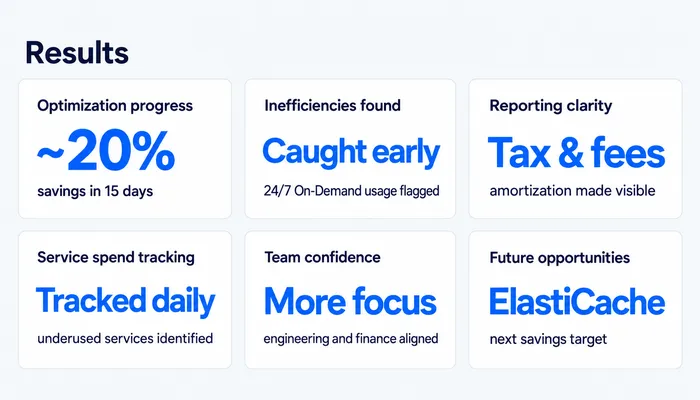
When all the changes were implemented, the difference was evident:
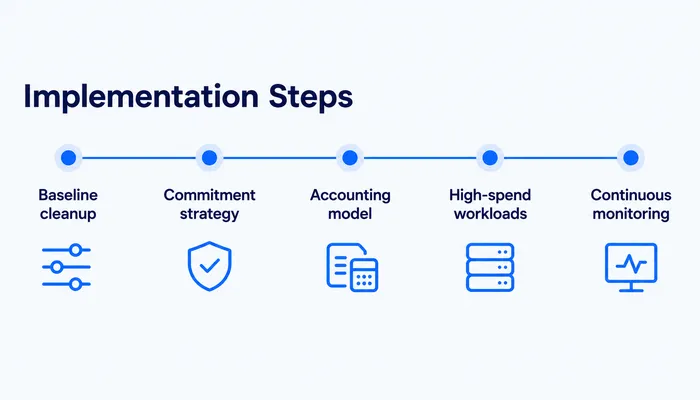
ThinkSys reviewed all AWS service costs, eliminated unneeded instance overhead, and isolated recurring production workloads from temporary usage spikes. This cut down on unnecessary baseline spend while still preserving full production performance.
ThinkSys looked at several commitment options and went with a combination of AWS Compute Savings Plans and RDS Reserved Instances. It was a good fit because it provides high discount rates, supports parallel multi-account coverage across CaptainU and MLQVentures, maintains instance flexibility, and requires zero architectural changes.
ThinkSys also developed a tailored cost tracking framework that matches CaptainU's linked account architecture. We focused on creating reusable reporting structures and clear metric organizations. The system includes detailed daily logging, tax amortization, account settings, and tracking points for expanded future optimization.
ThinkSys took a strategic approach by targeting the most budget-critical services first. We started with workloads labeled RDS Aurora MySQL and EC2 Compute. On May 16, 2026, we activated Compute Savings Plans, followed by RDS Reserved Instances on May 19, 2026. This delivered quick results and proved the strategy's value while establishing a foundation for broader coverage.
The ThinkSys cloud optimization team integrated commitment utilization metrics and daily cost tracking directly into the existing CI/CD pipelines. This ensures that infrastructure changes are monitored for cost impact in real-time before deployment. While there were initial adjustments regarding upfront commitment billing (such as the June 1 RDS RI fee), transparent accounting alignment across both primary and supporting accounts now ensures stable, predictable cost visibility.
ThinkSys successfully transformed CaptainU’s cloud infrastructure management. By shifting away from reactive on-demand billing, CaptainU now enjoys predictable, stable operating margins that allow the team to prioritize platform innovation over infrastructure firefighting. This successful implementation demonstrates the impact of ThinkSys’s expertise in achieving measurable cost reduction and operational efficiency.
Looking to achieve similar results? As your cloud optimization partner, ThinkSys helps organizations identify spending inefficiencies early, streamline financial reporting, and transform infrastructure spend into a strategic advantage. Contact ThinkSys today to learn how we can help your team optimize, scale, and work smarter.

About the Author
Sumukhi Sharma
Expertise in End-to-End Manual Testing, Quality Assurance Strategy, Cross-Functional Team Management, and Agile Scrum Practices with 10+ Years of Experience Delivering High-Quality Software Solutions Across Diverse Domains.


