QA Interview Questions & Answers for Hiring High-Quality Test Engineers
The first step towards building software is to get the right professionals. Testing being among the most integral parts of the software development lifecycle, hiring skilled quality test engineers is often a challenge faced by leading organizations.
Demand for software testing talent is growing steadily, as the U.S. Bureau of Labor Statistics projects employment for software developers, QA analysts, and testers to grow 15% between 2024 and 2034, with over 129,000 openings each year.
Despite this demand, finding engineers who can protect quality is difficult. Many candidates understand testing tools but lack the deeper engineering mindset required to design reliable test strategies or anticipate system failures.
Hiring the wrong candidates can lead to production defects, customer-visible outages, costly post-release fixes/delayed releases, revenue loss, and reduced user base.
Modern QA roles now require:
- Automation expertise
- CI/CD integration
- Debugging and root cause analysis
- Collaboration with developers
This guide covers the most important QA interview questions used by engineering leaders to evaluate real-world testing capability and build high-performing QA teams.
Many fast-growing teams facing QA hiring challenges choose to work with dedicated QA teams to ensure consistent quality and faster releases.
Why This Guide Matters for Engineering Leaders
If you’re facing any of these issues, this guide is especially relevant:
- Your releases are going out with production bugs
- Your QA hiring cycles are taking months
- Automation exists but is unstable or flaky
- Developers are spending time debugging instead of building
- Your QA team cannot scale with product growth
Why QA Questions Matter for Engineering Teams
Software quality directly impacts business outcomes, which makes hiring QA engineers a high-risk decision.
Key reasons:
- Poor software quality costs billions annually
- Bugs found late are exponentially expensive
- Debugging ability reflects real engineering depth
- Frequent releases increase risk of defects
- Automation is now essential for CI/CD pipelines
Many organizations struggling with inconsistent release quality turn to QA outsourcing services or managed testing services to reduce risk and improve delivery consistency.
- Software Defects Create Massive Financial Impact: Software quality issues are not limited to technical inconvenience; they also entail economic losses. According to the Consortium for Information & Software Quality (CISQ), poor software quality costs the U.S. economy over $2.4 trillion in a single year. As testing is directly related to product stability and user base, bugs in released software can repel users, hence the revenue.
- More Time Taken to identify a Bug, the More Expensive it Becomes: Bugs identified later in the development stages are expensive to fix, especially when they reach customers. Having skilled QA professionals not only reduces maintenance costs but also improves the customer experience and reduces bugs in production.
- Debugging Ability Reveals True Testing Expertise: Identifying a defect is only the first step. Strong QA engineers need to investigate the system behavior and collaborate with developers to isolate the root cause. The interview questions should focus on debugging scenarios as they reveal how candidates think under real engineering conditions.
- Release Quality Affects Customer Trust: Frequent software releases increase the risk of quality issues reaching production. Without effective QA practices, teams may ship updates faster but also introduce bugs that damage user experience and brand reputation.
- Automation Testing Experience is Crucial: CI/CD pipelines rely heavily on automated testing to validate builds quickly. As per the World Quality Report, over 70% of organizations prioritize test automation to maintain release speed without sacrificing quality.
- QA Fundamentals Interview Questions: When interviewing QA engineers, you need to begin with foundational questions to reveal how well the candidate understands the core principles behind software quality. Such questions will help you determine whether the candidate has practical experience in testing environments or only theoretical knowledge.
Below are commonly used QA fundamentals interview questions along with answers that a strong candidate should be able to explain.
- What is Software Testing?
Software testing is the process of evaluating an application to ensure it meets the desired requirements and is free of bugs that could affect users. The goal of software testing is not just to find bugs, but to verify that the system remains stable under various conditions, reducing the risk of failures before it’s released for users. - What is STLC?
Software Testing Life Cycle is a structured process followed by testing teams to ensure systematic testing. The stages of STLC are requirement analysis, test planning, test case design, environment setup, test execution, and test closure. Each stage helps ensure that testing activities are organized and aligned with development progress. - What is a Test Case?
A test case is a documented set of conditions, inputs, actions, and expected results used to verify a specific functionality of an application. It helps ensure that testing is repeatable and that different testers can consistently validate the same functionality. - What Makes a Good Test Case?
A good test case should be clear, concise, and easy to execute with well-defined inputs and steps that anyone on the team can follow. Effective test cases also cover both positive scenarios and edge cases to ensure the system behaves correctly in varying conditions. - What is the difference between QA and QC?
Quality Assurance focuses on preventing defects by improving development and testing processes. It involves activities like defining standards, designing testing strategies, and improving workflows.
Quality Control, on the other hand, focuses on identifying defects in the product itself and mainly involves executing test cases, validating functionality, and reporting issues.
In simple terms, QA improves the process while QC verifies the product. - What is a defect or bug?
A defect is a flaw in the software that causes the system to behave differently from the expected result. They occur due to errors in requirements, design, coding, or configuration. It’s the tester's role to identify defects during testing and report them so developers can fix them before release.
Many engineering teams realise that evaluating QA fundamentals alone is not enough.
The real challenge is identifying engineers who can apply these concepts in complex systems.
This is where companies often rely on experienced QA partners or dedicated testing teams that bring structured testing frameworks and real-world expertise from day one.
Evaluating Automation Testing Skills
With frequent releases and fast release cycles, organizations cannot rely on manual testing alone to meet strict deadlines. Given that, automation testing has become a core skill for QA engineers. Automation allows teams to validate builds quickly and detect failures before they reach production.
Because of this shift, engineering leaders focus on evaluating the following areas during QA interviews:
- Automation Framework Knowledge: You need to assess whether candidates understand how automation frameworks are structured and maintained, as well as strategies for keeping automation suites scalable.
- CI/CD Integration: GitLab’s DevSecOps Report notes that more than 60% of development teams rely on CI/CD pipelines for software delivery. Your interview questions should explore how candidates integrate automated tests into build pipelines and manage failures during automated runs.
- Tool Expertise: Skilled QA engineers should be comfortable working with common automation tools. Make sure to evaluate experience with tools along with knowledge of reporting and maintaining stable automation environments.
Note: Teams that lack strong automation expertise internally often rely on QA partners to design and maintain scalable automation frameworks.
Automation Testing Interview Questions
Automation testing is one of the most significant skills a QA professional should have. Whether you’re hiring or giving the interview, you need to ensure the answers have clarity of thought and showcase practical experience.
Interviewees should look for clarity in decision-making, real-world trade-offs, and systems thinking in answers, while interviewers should focus on demonstrating ownership, practical experience, and long-term thinking in their responses.
- What, according to you, is automation testing?
Automation testing involves utilizing scripts and tools to execute test cases and generate reports automatically. However, its purpose is to create a reliable feedback system that continuously validates product quality and is most effective when used to support regression testing and continuous integration, ensuring that frequent code changes do not break existing functionality. - When should you use automation testing?
Not every test case should be automated. It should be applied where it delivers clear value, and the real value lies in automating repetitive, high-volume, and business-critical scenarios. The right approach is to evaluate stability and maintenance cost before deciding which test case to automate. - How do you decide which test cases to automate?
When it comes to test case selection, it should always be driven by impact and efficiency. Critical user flows, frequently executed tests, and regression-prone scenarios are high-priority areas for automation testing. At the same time, unstable or frequently changing features can be avoided until they stabilize. - What tools have you used and why?
The entire tool selection is based on project requirements. If the priority is speed and ease of use in testing dynamic web applications, then Cypress and Playwright are the top choices. However, for broader ecosystem and cross-browser testing, Selenium remains the top pick. - What challenges have you faced in automation testing?
Automation testing can be challenging at times. For me, handling flaky tests and ensuring alignment with fast-paced development cycles are the top challenges. Handling these challenges involves using reusable components, continuous refactoring, better framework design, and close collaboration with development teams to improve testability from the beginning. - How do you integrate automation into CI/CD pipelines?
The goal of integration automation into CI/CD pipelines is to ensure continuous validation of code changes. Typically, smoke tests are executed on every build to catch critical failures early, while larger regression suites run at later stages. Also, proper reporting and alerting mechanisms are essential to address failures rapidly without blocking delivery.
While automation skills are critical, building and maintaining reliable automation frameworks is equally challenging.
Note: This is where internal QA models often break and companies bring in QA partners to stabilize automation, improve coverage, and reduce release risk.
Scenario-Based QA Interview Questions
Asking about concepts and tools is more about assessing the candidate’s conceptual and theoretical knowledge, but another significant part of the interview is assessing practical skills. Scenario-based questions are the perfect way to evaluate how the candidate will perform under challenging situations.
For interviewers, the goal here is to evaluate:
- Whether the candidate can break down a feature into testable components.
- Their ability to think in terms of edge cases, risks, and user behavior.
- How well they balance functional, usability, and negative testing.
- Whether they bring structured thinking instead of random test ideas.
- How do you collaborate with developers in automation testing?
Software development testing is a collaborative process that requires teamwork. Instead of treating testing as a separate phase, it works well when QA is involved during requirement discussions or design reviews. For instance, discussing testability upfront can prevent many automation challenges later. Also, regular communication helps when debugging failures, as developers can provide quicker insights into code-level issues. - How would you test a mobile app?
When testing a mobile app, it’s not just the functionality that should be considered. Given the vast scope of the program, testing should focus on core features, device compatibility, screen sizes, OS versions, network conditions, offline scenarios, and interruptions caused by calls or notifications.
Performance aspects such as app launch time, battery usage, and responsiveness are equally important. In practice, a combination of manual testing and targeted automation is used to ensure consistent quality across devices. - How would you test a login page?
The first step would be to understand the expected behavior of the page. Once that’s clear, from there, testing would begin with functional scenarios such as valid login, invalid credentials, empty fields, incorrect formats, and more. Afterwards, attention would shift to edge cases to test boundaries of the software functionality. Security is also a critical factor, so tests should involve SQL injection and brute force attacks. - How would you reproduce a bug?
The first step towards diagnosing is to reproduce the bug and understand what happened. That usually means checking logs, screenshots, or the provided steps. From there, the goal is to recreate the exact conditions using the guidelines, and the issue will be reproduced.
If the issue doesn’t reproduce immediately, it helps to vary inputs slightly, such as different devices and user stages. In many cases, bugs are tied to specific edge conditions rather than the main flow. - How would you test a feature with incomplete requirements?
Facing incomplete requirements is quite common. To tackle that, my approach would be to clarify as much as possible by discussing with product managers, developers, stakeholders, or any other relevant person involved with the project to fill obvious gaps.
Simultaneously, testing cannot always wait, so the approach would be to rely on assumptions based on similar features. These assumptions should be clearly documented to avoid confusion later. - How would you prioritize testing when time is limited?
When time is constrained, testing needs to be risk-driven. The focus should be on areas that have the highest impact on users or business, such as critical workflows and recently updated areas.
`Rather than testing the entire software, the preferred approach is to ensure that the most vulnerable and important parts are stable. For that, smoke testing and critical path validation usually take priority.
Instead of testing everything, it’s more effective to ensure the most important parts are stable. Smoke testing, critical path validation, and recent changes usually take priority.
Scenario-based evaluation reveals real-world thinking, but developing this level of QA expertise internally can be difficult — especially for fast-scaling teams.
Note: This is one of the reasons companies explore managed QA services to bring in experienced testing capabilities quickly.
QA Engineer Evaluation Checklist
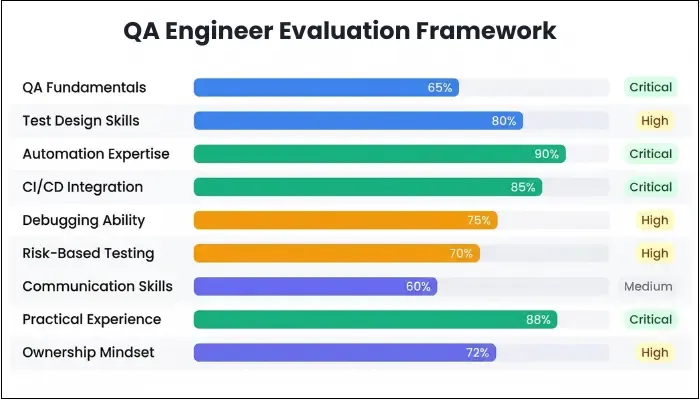
Each candidate has different strengths and weaknesses, and it’s crucial to evaluate them accordingly to attain a clearer picture of their skills. Having a well-defined checklist allows you to ensure consistency, ensuring that every candidate is assessed against the same criteria. Consider the checklist as a way to measure the candidate's capability across multiple QA dimensions.
A strong evaluation framework should combine observable behaviors, measurable indicators, and clear scoring, so decisions are based on evidence rather than impressions.
QA Engineer Evaluation Framework
| Evaluation Area | What to Evaluate | How to Measure | Overall Rating (1–5) |
| QA Fundamentals | How clearly the candidate articulates core testing concepts and whether they can connect them to practical scenarios. | Ability to explain testing, STLC, QA vs QC with real examples. | |
| Test Design Skills | Observe how they break down a feature into meaningful, complete test scenarios. | Breaks features into logical scenarios, includes edge cases and negative paths. | |
| Automation Expertise | Evaluate the candidate’s understanding of how automation frameworks are built, organized, and maintained over time. | Explains framework design, test organization, and maintenance approach. | |
| CI/CD Integration | Determine whether the candidate understands how automated tests fit into modern delivery pipelines and release workflows. | Describes how tests run in pipelines, handles failures, and reports. | |
| Debugging Ability | Examine how effectively the candidate can trace issues, reproduce defects, and isolate root causes. | Explains how to reproduce, isolate, and analyze defects. | |
| Risk-Based Testing | Identify whether the candidate prioritizes testing based on business impact and potential failure areas. | Identifies critical paths, business impact, and testing trade-offs. | |
| Communication Skills | Review how well the candidate conveys ideas, explains decisions, and collaborates in a technical context. | Explains concepts clearly, aligns with developers and stakeholders. | |
| Practical Experience | Look for evidence of hands-on experience through examples, challenges faced, and solutions implemented. | Shares relevant examples, challenges, and solutions. | |
| Ownership & Quality Mindset | Understand whether the candidate takes responsibility for overall product quality rather than just executing assigned tasks. | Thinks beyond execution, focuses on prevention and long-term impact. |

Overlooked QA Hiring Mistakes
Many times, even experienced engineering teams make costly mistakes when hiring QA engineers, often without realizing the long-term impact. The challenge is not just identifying candidates who can test, but recognizing who can protect product quality under real delivery pressure. When hiring decisions miss that mark, the consequences include unstable releases, delayed deployments, growing defect backlogs, and reduced revenue.
Below are some of the common yet overlooked QA hiring mistakes:
- Hiring for Speed Instead of Depth: Oftentimes, under delivery pressure, teams prioritize candidates who can get things done quickly. The problem is that speed without depth leads to shallow testing, which you need to avoid at all costs.
- Prioritizing Tools: Familiarity with tools is significant, especially for automation testing, but overemphasizing the same can be a limitation. Tools may change quickly, but what stays relevant is how the candidate approaches problems. Teams that hire solely on tool experience often end up with engineers who can execute scripts but struggle to design effective test strategies.
- Not Testing How Candidates Handle Ambiguity: Real-world projects rarely come with perfect requirements. Yet interviews often focus on well-defined scenarios with perfect conditions. Candidates who perform well in structured discussions may struggle when requirements are incomplete or constantly evolving.
- Overvaluing Past Company Experience: Hiring decisions sometimes lean heavily on brand names rather than actual contributions. A candidate from a trillion-dollar company may still have had a limited role. Without probing into what they actually did, teams risk hiring based on perception rather than capability.
- Not Evaluating Collaboration and Ownership: Agile teams rarely work in isolation. If the teams ignore communication and collaboration during hiring, they’re likely to face friction when debugging issues or aligning quality goals. The candidate should think beyond execution and should take ownership of product quality.
- Rushing the Hiring Process: Under pressure to fill roles quickly, hiring teams may sometimes skip structured evaluations or overlook common red flags, resulting in hiring candidates who perform well in conversation but lack depth in execution. The cost of a bad hire in engineering can be significantly higher than the cost of a delayed hire.
Many QA hiring mistakes stem from evaluating surface-level skills instead of real engineering capability.
If your team is struggling to find QA engineers who balance automation, testing strategy, and production-level thinking, working with an experienced QA partner can significantly reduce hiring risk.
QA Hiring Framework
When hiring a QA engineer, it’s best to follow a systematic approach. A good hiring framework showcases how quality works in a real project. When used consistently, the following framework can help you reduce hiring risk and identify candidates who can contribute from day one.
Step 1: Define the QA Role
The first thing you need to do is define what quality means for your team. A product in early stages needs someone who can explore and question behavior, while a mature system often requires strong automation and regression control. By defining the role, you get a clearer picture of what you should be looking for in a QA engineer.
Step 2: Map Real Engineering Problems
Once you get a picture of what you want, it's time to translate your existing quality challenges into interview focus areas. If releases are unstable, emphasize debugging and root cause analysis. Also, try to incorporate some issues you may expect in the future. Doing so keeps interviews grounded in reality instead of drifting into generic questioning.
Step 3: Structure the Interview in Layers
To ensure that you evaluate the candidate thoroughly, it's advised to take a layered approach. First, validate fundamentals to ensure that the candidate understands core QA concepts. Next, move into automation and technical depth to assess hands-on clarity. Lastly, use scenario-based discussions to evaluate how the candidate thinks in real situations.
Step 4: Evaluate Using Consistent Criteria
During each round, assess the candidate against defined parameters such as test design, automation thinking, debugging ability, and communication clarity. When it comes to scoring, it should be based on how well the candidate explains decisions and handles complexity, not how confidently they speak.
Step 5: Test Automation Understanding Practically
One of the commonest interview questions is ‘Which automation tools are you familiar with?’ Instead of asking which tools they know, explore how they have used automation in real situations. Ask how they designed frameworks, handled flaky tests, integrated tests into pipelines, and more. Such questions will help you separate candidates who have worked on real systems from those who have only followed tutorials.
Step 6: Make the Decision Based on Capability and Fit
The final decision should consider the candidate’s overall performance across all layers. Find out their consistency in thinking, not isolated strong answers. A strong QA hire is someone who can adapt to your system and take ownership of quality as the product evolves.
Should You Hire QA Engineers or Work with a QA Partner?
Choosing the right QA model is critical for long-term product quality.
| Approach | Best For | Limitations |
| In-house QA | Stable teams with predictable workloads | Slow hiring, high cost |
| Hybrid QA | Flexible scaling | Coordination challenges |
| Managed QA Services | Fast-growing teams needing expertise | Requires onboarding |
Note: High-growth SaaS companies often prefer managed QA services or dedicated QA teams to scale testing without hiring delays.
How Modern Engineering Teams Structure QA
QA today is focused on how fast teams ship and how much quality risk they can afford. Some teams prefer high control, others need flexibility, and many are trying to balance both. With that in mind, QA is no longer tied to a single structure; there are three different models followed: in-house QA, hybrid QA, and managed QA services.
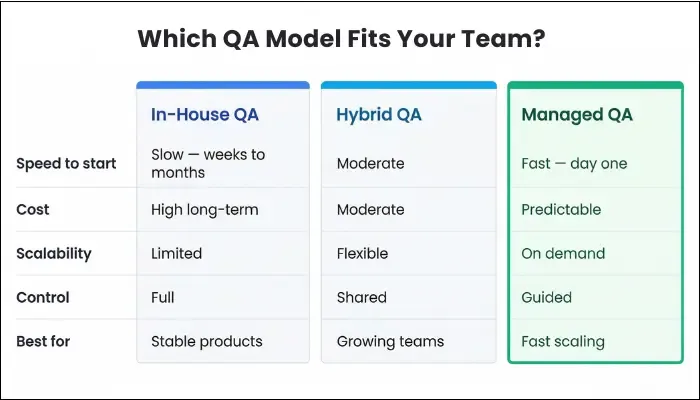
The majority of organizations now rely on external QA support in some capacity, mainly to manage scale and specialized testing needs.
Industry data reflects this shift. The World Quality Report shows that a majority of organizations now rely on external QA support in some capacity, mainly to handle scale, speed, and specialized testing needs.
In-House Teams
As the name suggests, the organization hires QA specialists to test its in-house products. Here, the testers work closely with developers and product managers, building strong familiarity with the system over time. The benefit of having an in-house team is utmost control, but this control comes with a high cost. The pros and cons of having in-house teams are discussed below:
Pros of an In-House QA Team
- In-depth product knowledge.
- Smoother communication and collaboration with other teams.
- Strong alignment with long-term product goals.
- Free from cultural, language, and time zone boundaries.
Cons of an In-House QA Team
- Scaling is challenging during high demand.
- High long-term cost with salaries, benefits, infrastructure, and insurance.
- Hiring skilled QA engineers is time-intensive.
- Limited exposure to evolving tools and practices.
In-house QA teams are suitable for companies with stable products, but they often struggle with varying testing demands.
Hybrid QA Teams
The next, and among the most popular, team model is a mix of in-house team members and external specialists. Companies can allocate tasks to dedicated teams depending on the priority, and each team collaborates to get the job done. For instance, the in-house team can handle the core product knowledge and daily testing, while external QA experts can support automation or large regression cycles.
Pros of a Hybrid QA Team
- Flexible scalability when demand arises.
- Access to both in-house QA expertise and external opinion.
- Faster adoption of advanced testing practices.
- Affordable as compared to an in-house team, while getting better outcomes.
Cons of a Hybrid QA Team
- Complex collaboration between the in-house and external teams.
- Knowledge transfer gaps can occur if not managed properly.
Many growing companies prefer a hybrid model as it balances control with flexibility. In addition, it allows teams to stay lean internally while still handling complex testing needs effectively.
Managed QA Services
Hiring an in-house QA team poses several challenges and limitations that may hinder growth for growing organizations. Having a dedicated external QA team allows internal teams in such organizations to focus on their product and growth while the external team handles testing. From testing planning to execution and reporting, the QA service provider manages everything while aligning with the company’s development process.
Pros of Managed QA Services
- Immediate access to experienced QA professionals and frameworks.
- Faster setup compared to building an in-house QA team.
- Reduced management overhead for internal teams.
- Smoother collaboration between teams.
- Round-the-clock support.
- Scalability is never an issue with managed QA services.
Cons of Managed QA Services
- Requires strong onboarding and communication to align with product goals.
- Lesser direct control compared to in-house teams.
Managed QA services are the top preference of companies looking to scale quickly or reduce internal overhead. It is highly effective when combined with clear processes and defined expectations.
When Companies Choose Dedicated QA Teams
Initially, when the project requirements are minimal, they can be fulfilled with in-house QA teams. As a result, most teams don’t plan for external QA from the start. The shift occurs after a few repeating patterns. At that point, the question is no longer whether help is needed, but how to bring it in without slowing everything down. The following are the top situations when companies determine it’s time to bring in dedicated QA teams:
- When release cycles start tightening: With the rising frequency of deployments, internal QA may struggle to keep up with regression coverage. Instead of compromising on quality or overloading the team, companies bring in dedicated QA support to stabilize releases.
- When product complexity increases: What used to be a simple system turns into multiple workflows, integrations, and edge cases. Testing effort grows faster than expected, and without additional support, coverage gaps begin to appear. In that case, external QA teams are the perfect solution.
- When automation starts becoming a bottleneck: Automation suites showcase signs such as flaky tests and slower pipelines that depict degradation. In that case, companies bring external QA teams to rebuild the structure and restore trust in automation.
- When developers spend too much time on testing: The goal of developers is to build the software. Instead of focusing on building features, if the developers get pulled into debugging avoidable defects, it shows that the existing testing is inefficient. Dedicated QA support helps shift that responsibility, allowing developers to focus on their core task.
- When multi-platform testing becomes difficult to manage: Testing across web, mobile, browsers, and operating systems quickly becomes overwhelming. External QA teams are usually equipped with the tools and environments needed to handle this complexity efficiently.
Note: At this stage, the question is no longer whether QA support is needed, but how to bring it in without slowing down delivery.
Why QA Hiring Becomes a Bottleneck for Growing Teams
As teams scale, QA hiring often becomes a constraint.
Common challenges:
- Long hiring cycles
- Inconsistent QA quality
- Lack of automation expertise
- Developers spending time on testing
- Growing backlog of defects
Note: This is why many engineering leaders shift from hiring individuals to building scalable QA systems through external expertise.
The Hidden Cost of Delaying QA Improvement
Many teams continue hiring QA engineers without fixing the underlying system.
The result:
- Increasing defect leakage into production
- Slower release cycles despite more engineers
- Rising QA costs without measurable improvement
- Developer productivity loss
- Customer churn due to instability
At this stage, the problem is no longer hiring. It’s the absence of a scalable QA strategy.
Conclusion
Hiring QA engineers is not just about filling a role, it’s about protecting product stability as your system grows.
Modern QA expectations have expanded significantly. Engineers must:
- Understand automation deeply
- Work within CI/CD pipelines
- Maintain quality at scale
Evaluating all of this consistently is difficult.
Note: This is why many teams move beyond traditional hiring and choose QA partners who bring proven frameworks, experienced engineers, and scalable testing systems.
Why Engineering Teams Trust ThinkSys
Engineering teams choose ThinkSys not just for testing support, but for building reliable quality systems.
- Proven experience across SaaS, healthcare, fintech
- End-to-end testing across web, mobile, and APIs
- Scalable automation frameworks (Playwright, Selenium)
- Ability to stabilize existing QA systems
Note: ThinkSys engineers don’t just execute test cases — they design quality systems that scale with your product.
Make QA Reliable Without Slowing Down Releases
Instead of spending months hiring QA engineers, work with a team that is ready from day one.
With ThinkSys, you get:
- Dedicated QA teams
- Automation specialists
- Faster testing cycles
- Reduced production defects

Frequently Asked Questions (FAQs)
Share This Article:
 Previous Post