Every Low-Code Testing Tool vs. Playwright: Find Your Breaking Point (2026)
Summarize With:


Here's the thing nobody at these tool vendors will say out loud.
Everything they sell - cross-browser runs, parallel execution, API tests, visual checks, self-healing, Playwright already does. For free. The license fee isn't buying you testing capability. It's buying you permission to skip hiring Playwright talent.
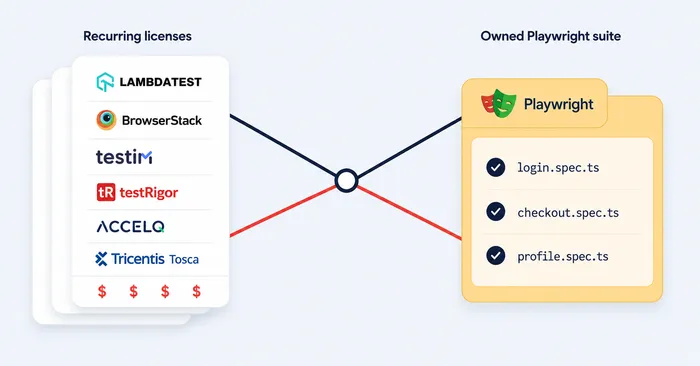
That's a real thing to sell. Some teams should pay for it. But it changes what this comparison actually is. You're not comparing tools. You're comparing their license price against the cost of closing your talent gap.
And at some point, the license costs more. We call that moment the breaking point. Every tool below gets its own verdict: the team size or spend where switching wins.
Find yours before the renewal call. Not after.
Renewal Coming Up? Get Your Breaking Point Calculated.
Low-Code Testing Tools vs. Execution Grids vs. RPA: What's Actually Comparable
Most "tools vs. Playwright" articles fail in the first paragraph. They compare things that aren't even in the same business. Three buckets:
- Execution grids: LambdaTest, BrowserStack. Not rivals. These are places Playwright runs. Thousands of teams execute their Playwright suites on these grids every day. The only real overlap is the grids' AI-authoring add-ons, like LambdaTest's KaneAI. Those compete with Playwright's AI ecosystem. The grids themselves? Complementary.
- Actual low-code platforms: Tosca, Katalon, Mabl, Testim, testRigor, Leapwork, ACCELQ, TestComplete, Ranorex, Virtuoso. Tests built with recorders, visual flows, or plain English instead of code. This is the real comparison. This is the rest of the page.
- RPA suites with a testing module: UiPath Test Suite. Fine if you're already a UiPath shop. An odd first pick if you're not.
If an article puts LambdaTest and Tosca in the same "Playwright alternatives" list? It was written to rank on Google, not to help you. Moving on.
Low-Code Testing Tool Pricing 2026: The Master Comparison Table
| Tool | Verified pricing | Billing model | Breaking Point | Deep dive |
| Tricentis Tosca | Named ~$3.5K-$5K/user/yr, execution agents ~$1K-$2K each; mid-size deployments €40K-€100K+/yr, and enterprise $200K+ | Per-user AND per-agent modules are priced separately; renewals reported +15-20%/yr, plus 2-4 weeks training per person before productivity | Immediate for web products; never for SAP shops | Playwright vs. Tosca → |
| Katalon | Studio free; Studio Enterprise $2,199/seat/yr ($1K first yr) 3); Runtime Engine ~$1.8K-$2.4K/node/yr; TestOps Premium ~$59-$80/user/mo | Dual meter: seats AND CI nodes billed independently - "Studio is free, CI is not." A 5-engineer team with 2 KRE nodes models at $7.2K-$9.6K/yr before TestOps | ~8-12 seats, or the sprint you add your third KRE node | Playwright vs. Katalon → |
| Mabl | Starter: ~$499/mo; Growth: $1.2K-$3K/mo; Enterprise: $40K+/yr (Vendr median) | Credit meter: ~500 cloud-run credits at base; full regression on every PR can drain a Starter pool in a day - the workflow modern teams want is the one the pricing punishes | When you hit the credit wall or start reviewing healing decisions, whichever comes first | Playwright vs. Mabl → |
| Testim (Tricentis) | Small-team contracts $15K-$50K/yr (Vendr transaction data) | Execution-based: priced by run volume / parallel sessions - scaling CI concurrency scales the bill; now inside Tricentis contract structures post-acquisition | ~$20K annual spend, or first portfolio repricing | Playwright vs. Testim → |
| testRigor | Not published; third-party estimates ~$900-$2K/mo for private plans; free open-source tier exists | Quote-gated; the real price is the exit - plain-English tests export to no executable format | Before signing - model 3-year spend vs. rebuild first | Playwright vs. testRigor → |
| Leapwork / ACCELQ | Quote-based; reported $20K-$60K+ / ~$2.5K-$5K per user | Proprietary flow/model formats; maintenance relocates rather than disappears | When flow-tending ≈ one engineer's time | Playwright vs. Leapwork → |
| TestComplete / Ranorex | ~$2K-$4K/license; ~$3.5K+/seat | Honest niche: desktop apps, which Playwright doesn't touch | Web teams: now. Desktop needs: keep for desktop | Playwright vs. TestComplete → |
| UiPath Test Suite | Quote-based platform stack | Orchestrator + robots + Studio - a platform, not a tool | Binary: UiPath shop, keep it; else, before purchase | Playwright vs. UiPath → |
Note: Pricing gets re-verified quarterly and stamped, so your readers always see current numbers.
Cost Comparison: Low-Code Platform vs. In-House Playwright vs. Managed
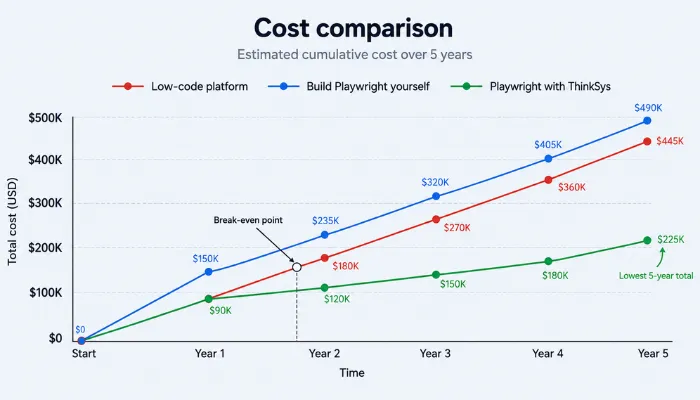
Let's make this concrete. Assume 500 test cases over 5 years, a loaded SDET rate of ~$150K/year, and a loaded QA rate of ~$100K/year. (Test cases should last the life of the product, but five years is enough to see the shape. And yes: at 1,000 test cases, double every labor figure below: maintenance allocation scales with suite size, roughly 50% of a person per 500 tests.)
| Cost area | Low-Code Platform | Build Playwright Yourself | Playwright with ThinkSys |
| License / engagement | ~$40K/yr, every meter counted→ $200K over 5 yrs. | $0 | $175/test case → $87,500 build, one time, in your repo. |
| Labor; someone still does the work | Authoring + maintaining in the tool: ~50% of a QA person → ~$50K/yr, $250K over 5 yrs. ("No engineers needed" ≠ "no people needed") | Year 1: full SDET, $130K–$180K + 2-4 mo search. Years 2-5: ~50% allocation for 500 tests → $65K-$90K/yr | $60/test case/yr → $30,000/yr flat if we maintain, less than half the cost of a 50% internal allocation or your team takes over at their own allocation. |
| Infrastructure | Bundled in the license, part of what you're renting; cloud execution often metered extra | Your CI compute: ~$3K-$8K/yr . | Same CI compute, ~$3K–$8K/yr. |
| Time to coverage | Days-weeks (the honest low-code win) | 4-6 months | 2-6 weeks |
| What you own at 5 years | Tests in their format, meter still running | Everything; if the architect stays(The suite and the capability) | Everything; your repo from day one, transfer date in the contract(The suite, the capability, and a trained team). |
| 5-YEAR TOTAL | ~$430K–$460K | ~$405K–$570K (salary-years + infra), you own everything, if the architect stays | ~$210K–$240K (ThinkSys-maintained) |
Notice the shape. The platform is cheapest in month one and most expensive by year three. DIY is the opposite. The partner path is the only column that's fast and ends with you owning everything.
Still not sure which is right for you? Schedule a call with one of our experts.
When Low-Code Genuinely Wins
Three cases where the honest answer is: keep the tool.
- Zero engineering capacity, and no path to any. No budget to hire. No one to train. No room for a partner. Then the license is your talent budget, and it's buying something real. Small teams under ~8-10 users often sit here comfortably.
One thing worth checking before you settle here: you're already paying for a tool. That money could pay for talent instead. A build-and-transfer engagement costs about the same as a year or two of license renewals, and at the end, your own testers run a suite you own. No hiring needed. If you still think there's no path for your team, spend 30 minutes finding out.
Convinced There's No Path to Playwright Talent for Your Team? Book a Free Consultation - We'll Tell You Honestly If You're Right. - Analyst-driven testing of packaged apps. The Tosca case. SAP-centric programs staffed by business analysts are Tosca's home field. Playwright isn't playing that sport.
- Small, stable, finished suites. Sixty tests. Product in maintenance mode. Cheap tier, touched twice a quarter. The math never crosses. Migrating would be motion, not progress.
In one of these? Renew without guilt. Not in one of these, and a growing team on per-user pricing is definitionally not, then the next section is for your renewal call.
Seven Questions to Ask Before You Renew
Bring these to the meeting. Better yet, forward this section to whoever attends it.
- Show us a full test export. Live. To what format? Runnable where? ("Our API provides access" is not an export.)
- What were our actual maintenance hours last quarter, despite the self-healing? Pull the data, not the vibes.
- What does this cost at next year's headcount on every meter? Seats, CI nodes, run credits, execution volume. Per-user pricing means your growth is their revenue plan; the second meter means your engineering ambitions are too.
- What happens to our tests if we leave? Get it in writing. That answer is the real price of the product.
- Which of our tests could a code framework not express? If the answer is "none", you're paying for authoring convenience, not capability.
- What price protection exists at renewal? Especially if the vendor just got acquired.And ask for it against the reported pattern: Tosca customers describe 15-20% annual increases.
- Name a customer who left successfully. Confident vendors have them ready. The pause before the answer? That's data too.
Bottom Line
Low-code platforms are talent workarounds priced as subscriptions. Playwright is the capability, priced once.
The tools aren't scams. Everyone above does something real, we said what, tool by tool. But per-user, per-year, forever,on meters that scale with your ambitions, for tests you can't take with you? That has a crossing point with just owning the thing. For most growing teams, it's closer than the renewal quote makes it look.
That crossing point is calculable. We'll calculate yours honestly, including telling you if you haven't reached it yet.
Find Your Breaking Point - Book a Comparison Call With a Playwright Engineer.
Questions From the Community
1. Our renewal quote just doubled. What's a realistic escape path?
Answer: Three moves, in order.
- Use the quote as leverage. Vendors discount hardest against a credible exit, and mentioning a Playwright migration assessment is the credible exit.
- Run the real math before deciding. Export your coverage map (that exports even when tests don't), calculate your breaking point, and get an honest rebuild estimate, typically 8-14 weeks for a mid-size suite.
- If the math says go, negotiate a short renewal (six months, not twelve) to bridge the rebuild, run both in parallel through one release cycle, then cut over. Realistic total: one to two quarters from doubled quote to fully off the platform. The trap? The panic 12-month renewal that resets the whole clock.
2. My manager wants a codeless tool so "anyone can write tests." How do I push back without sounding like a snob?
Answer: Don't fight the goal. Fight the accounting. "Anyone can write tests" is true in every codeless tool, for about six months. Then someone becomes the flow-maintainer. The healing reviewer. The person who knows why test 214 breaks. That's automation headcount by another name, now stacked on top of license spend, in a format only that person can maintain. Bring two numbers to the meeting: the five-year license total at projected headcount (count every meter: seats, nodes, and credits) , and the cost of the same "anyone contributes" outcome via Playwright + AI authoring + one trained reviewer. Then concede the real case: if the team truly has zero engineering capacity and no path to any, the tool wins. That concession is what makes the rest sound like analysis instead of preference.
3. Our self-healing tool keeps "fixing" tests so they pass against the wrong elements. Normal?
Answer: Normal, documented, and the single most important thing to understand about the whole self-healing category. Healing is judgment without review. Most repairs are right. The wrong ones don't fail; they pass, silently, against whatever looked similar. Your test just went from protection to decoration. The fix is procedural, not vendor shopping: route healing decisions through human review (even sampling catches the drift), and treat "tests healed" as a metric that triggers inspection, not celebration. Then fold this into your renewal math, because once you're staffing review anyway, you're one Breaking Point calculation from owning the whole stack.
4. We're three manual testers, no coders. Is Playwright actually realistic for us or is that just what Playwright shops say?
Answer: Sometimes it genuinely isn't. So here's the honest sort. Small suite, stable product, cheap tier? A codeless tool below the Breaking Point is the right call, ignore vendors who say otherwise, including us. Playwright becomes realistic for a team like yours through exactly two doors: real training investment (months, with management actually protecting the time - one tester with scripting curiosity is enough of a seed), or a build-and-transfer partner where you inherit a working suite plus the skills instead of a blank repo. Neither door fundable? Then the license is your talent budget. Spend it without guilt, but take the seven renewal questions with you. "No coders today" shouldn't cost you portability forever.