Migrating Java Selenium to Playwright: A CTO's Decision Guide (with the Technical Playbook)
Summarize With:


Migrating a Java Selenium suite to Playwright is a release-risk decision, not a script-conversion project. Budget roughly 2-4 weeks per 100 tests after you've audited the framework around them (waits, Page Objects, CI, reporting, that's where the real cost hides). Run both suites in parallel for 2-3 months and retire Selenium category by category, never all at once. Stay in Java if your team is Java - Playwright's Java bindings are first-class. The payoff is concrete: our clients have cut regression run time from days to hours and dropped critical production bugs by ~90%. The technical playbook for your engineers is in the second half of this guide.
The Business Case: Why Teams Make This Move
Selenium still works. So the question isn't "is Selenium broken", it's "what is Selenium costing us that Playwright wouldn't?"
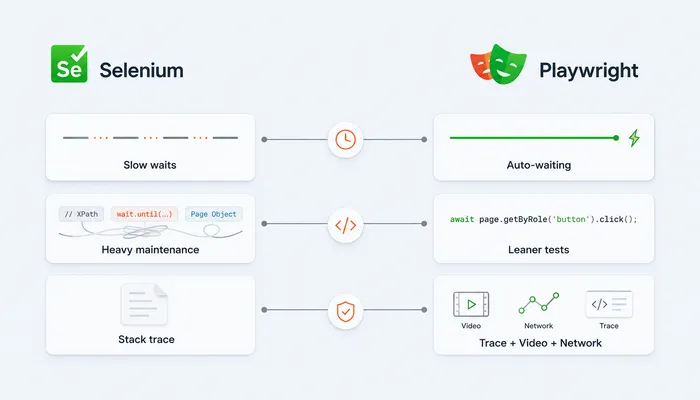
Three answers a CTO cares about:
- Release speed: Selenium's flaky waits and Grid overhead make regression slow and unreliable. Playwright's auto-waiting removes an entire class of flake, which shortens the feedback loop your releases wait on.
- Maintenance drag: A mature Selenium suite carries years of custom wait code, brittle XPath, and Page Object bloat that a senior engineer babysits instead of shipping features. Playwright's architecture lets you shed most of it.
- Confidence: When a Playwright job fails, it hands the engineer a trace, video, and network log — evidence, not a stack trace. Faster diagnosis, fewer "re-run and hope" cycles.
What that's worth, from real engagements:
| Client | Baseline | Outcome | Approach |
Real-time communications | 1,200+ active test cases · ~70% coverage · 5–7 day manual QA cycle · 6-hour sequential suite | QA cycle 5–7 days → ~2 hours. Suite execution 6 hrs → ~2 hrs with sharding. Coverage 70% → ~100%. Maintenance effort −25%. Deploys weekly → multiple per week. | Playwright + WebRTC mocking + sharded parallel execution. ~4 months to full production. |
Legal SaaS | <10% automation coverage on prior tool ($50K/yr) · 3–4 week manual regression · 15–20 critical bugs per release | Critical production bugs 15–20 → 1–2 per release. Regression cycle 3–4 weeks → 2 weeks. Flaky failures −85%. ~$120K/year saved. | Custom Playwright framework, CI-integrated. 300+ E2E steps covering 30% of regression. |
Travel platform | 8,000+ manual test cases · 2–3 week regression cycle | Suite consolidated 8,000 → ~2,000 journey-based cases. Riskiest 10% automated first. Regression moved into CI/CD; manual effort redirected to exploratory. | Consolidate-then-automate. Custom Playwright framework with FreshTracks' DevOps team. |
Weighing a Java Selenium migration? Get a free migration risk assessment - we'll size your suite and map the real cost.
The Four Business Mistakes That Turn a 3-Month Migration into a 9-Month One
Every stalled migration we've been called in to rescue made at least one of these. As a CTO, these are the four you own:
- Underestimating the work outside the tests. Teams price "converting 400 test files" and forget the driver setup, waits, Page Objects, reporting stack, retry policy, and CI ownership those tests depend on. That's where migrations get mispriced by 2-3x.
- Moving unreliable tests into the new setup. If you automate the bloat first, Playwright just runs your bloat faster. Clean the suite, then migrate.
- Keeping the old approval process. A new tool with the same slow, manual release gate doesn't speed anything up.
- Turning Selenium off before the new suite is trusted. The riskiest month is when both suites run and nobody knows which one owns release confidence. Cut too early and you ship a coverage gap.
How Long and How Much? A Straight Estimator
There's no honest fixed price, but there is an honest method. A 2026 TestDino benchmark gives a planning unit of 2-4 weeks per 100 Selenium tests, but that number is only real after you've assessed what supports those tests. The multiplier is framework complexity, not test count:
| Your suite looks like… | Where it lands |
| 400 clean tests, thin framework code, sensible waits | Faster end of the range |
| 150 tests wrapped in deep inheritance, unexplained sleeps, shared state, a reporting stack nobody will touch | Slower end, the tests are the easy part |
So the first thing to fund isn't conversion. It's a framework audit that sorts every asset into five buckets:
- Keep business flows, data builders, API helpers, domain language that still serve the product
- Rewrite selectors, waits, Page Objects, assertions that encode Selenium behavior
- Replace WebDriver lifecycle, Grid execution, report plugins, retry policy, browser setup
- Retire duplicate tests, stale checks, cases better covered at API or unit level
- Defer low-risk flows that shouldn't block your first Playwright release gate
Your first milestone should be tiny and concrete: one Playwright Java smoke flow running locally and in CI, producing a failure artifact an engineer can use without asking QA what happened. Until that exists, any estimate is theory.
The Question Every Java Shop Asks: Stay in Java, or Move to TypeScript?
Short answer: if your team is Java, stay in Java.
Playwright's Java bindings are first-class: role-based locators, auto-waiting, tracing, fixtures, and parallel execution all work natively. You do not need to change languages to get the core benefits, and forcing a Java team onto TypeScript mid-migration adds a skills risk on top of a coverage risk. Don't do both at once.
When TypeScript is worth considering (as a separate decision, made deliberately, not smuggled into every test-conversion argument):
- You want Playwright Test's newest features and the AI Test Agents ecosystem, which land in TypeScript first
- Your product is already TypeScript-heavy and consolidating languages reduces team context-switching
- You're rebuilding the suite so thoroughly that the language is a genuine open question
The rule: decide the language path once, write it down, and don't let it hijack every conversion conversation. A Java-to-Java migration is a smaller, safer, entirely valid project, and for most Java teams, the right one.
The Retirement Plan (Where Migrations Actually Fail)
The technical porting is the visible work. The dangerous part is the sunset, and it's a CTO-level call because it's about release confidence, not code.
Budget 2-3 months of parallel Selenium + Playwright CI before retiring Selenium. That overlap is only useful if every test category has an explicit exit gate:
- Audit: Classify every Selenium test: smoke, critical regression, integration, low-value, or retire
- Smoke first: Migrate deploy-blocking flows; retire Selenium smoke once Playwright smoke is stable in CI
- Critical regression: Migrate revenue, auth, data, compliance, and customer-visible flows; retire the Selenium equivalent only when Playwright catches the same release-blocking failures
- Integration: Migrate cross-service and data-heavy flows only after test-data isolation is solved
- Sunset: Remove Selenium jobs by category, not all at once
Phasing by calendar instead of by exit-gate creates the two failure modes: cut early → coverage gap; keep both forever → permanent double-suite maintenance debt. Neither is acceptable, and both are avoidable.
One regulated caveat worth flagging to your compliance owner: Selenium launches installed browsers; Playwright uses its own browser binaries. If you validate healthcare or regulated workflows against an exact user browser-and-OS pair, keep a thin Selenium or manual validation slice for that specific category. Everything else moves.
The Technical Playbook (For Your Engineers)
Everything above is the decision. Everything below is the implementation - hand this section to your automation architects and QA leads. It's Java-specific and assumes Playwright's JUnit integration.
Prove the Lifecycle Before Porting Anything
Before anyone converts the largest Selenium class, prove the new test lifecycle on one flow. Playwright's @UsePlaywright JUnit extension gives each test isolated fixtures : Page, BrowserContext, Browser, Playwright:
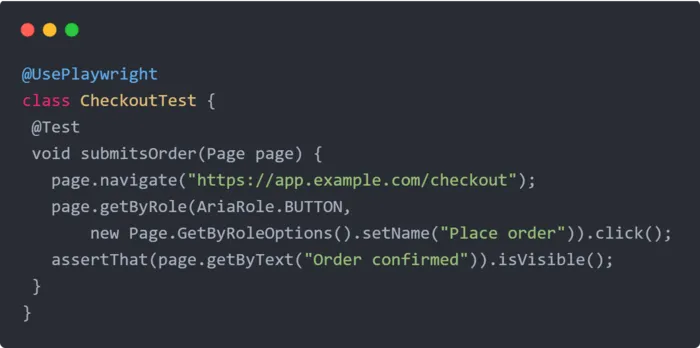
Each test gets its own Page, and that page belongs to an isolated BrowserContext. If you're not using the JUnit extension, the rule holds anyway: reuse Playwright and Browser where it improves runtime, but create a fresh BrowserContext per test so cookies, local storage, permissions, and session state never leak between tests.
This is where Selenium habits sneak back in a new costume. A static WebDriver becomes a shared Page. A global login becomes shared storage. A retry rule hides shared state. The code looks modern; the old failure pattern is still inside it. Set the rules before conversion starts:
- One browser context per test
- Base URL and environment profile set once
- Local and CI configuration separated
- Trace, screenshot, and video rules decided before the first failure
- Browser coverage tied to product risk, not developer preference
When one smoke flow passes in CI and gives useful failure evidence, you're ready to port.
Convert Locators by User Contract, Not by Syntax
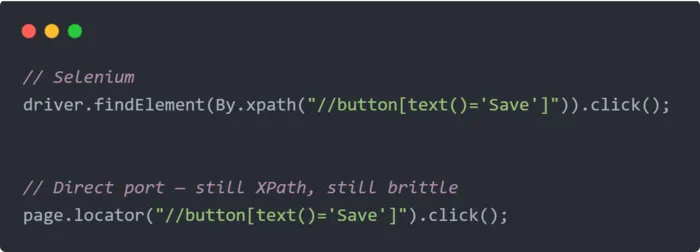
A green migrated test can still be a bad one, when the team keeps the old XPath map and only swaps the API around it. That carries Selenium's DOM-structure dependency into a tool built to work from what the user sees.
The lazy conversion (works, but inherits the brittleness):
The version that actually improves test quality:
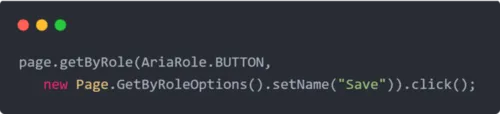
The second says what the user does: there's a Save button with the accessible name "Save," and the test interacts with it as a user would. Locator priority order:
- Role + accessible name: buttons, links, headings, menus, controls
- Label: form inputs
- Text: visible content assertions
- Test ID: when the product needs an explicit testing contract
- CSS / XPath: only when the UI exposes no stable user-facing label
If your suite is XPath-heavy, don't let engineers port it file by file. Write a locator policy first, add missing test IDs where the UI has no stable contract, then convert one business-critical flow under that policy before scaling.
Delete the Wait Code, Don't Port It
Custom wait code is usually the most expensive Selenium code, because it looks like infrastructure and nobody counts it as migration work.
Playwright auto-waits before every action — for a click, it confirms the target resolves to one element, is visible, stable, receives events, and is enabled. Playwright Java's assertThat assertions wait and retry until the condition is met. So wait migration starts with deletion:
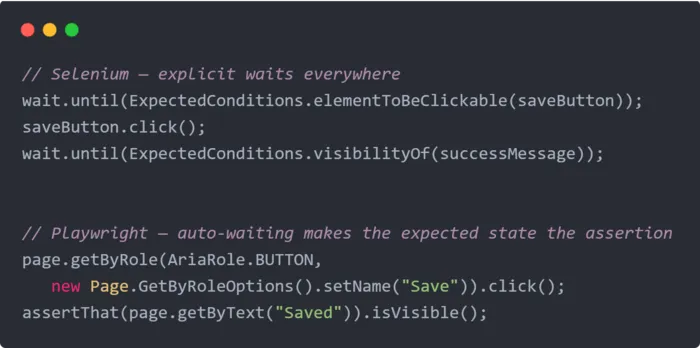
Review each wait before porting it. A visibility wait before a click is usually duplicate behavior. A sleep after navigation usually points to a timing bug. A retry around every action is often hiding weak data setup or shared state. Keep explicit waits only for real product state transitions Playwright can't infer from the DOM — payment processing, report generation, file export, message delivery. Those are product states, not browser-readiness states.
Done state: no shared sleep wrapper, no hidden wait logic inside Page Objects, every retained wait tied to a named product state.
Keep the Business Page Objects, Delete the Plumbing
If your suite has hundreds of Page Objects, you're not moving tests - you're moving an architecture. We've watched migration proposals die the moment a team counted 800 Page Objects. That's not irrational resistance; it's the team knowing where the real cost is.
So don't transplant the framework. Keep Page Objects that express business work. Delete or split the ones that only exist to hide WebDriver calls, waits, setup, screenshots, retries, or reporting - those responsibilities move to Playwright fixtures, setup, helpers, and CI artifacts. A good Playwright Java Page Object is smaller:
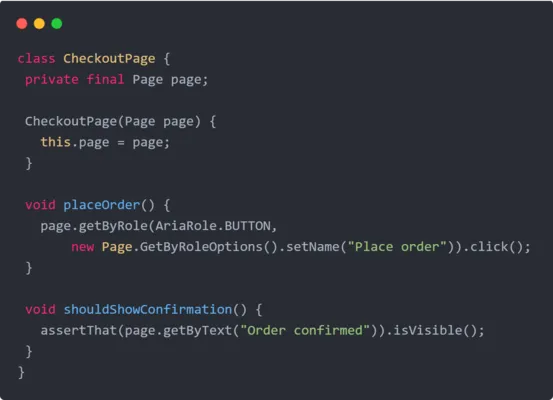
It keeps workflow language. It doesn't own browser startup, hide sleeps, manage retries, or decide how CI reports a failure.
For a suite of 800 Page Objects, the realistic path: expect a large share to collapse in the audit (plumbing POs merge into fixtures), a core of business-workflow POs to survive and slim down, and the migration to be sized against the survivors, not the original count. That reframe is often what makes an "impossible" 800-PO migration a manageable one.
Replace Grid and Reporting Together
Selenium Grid doesn't become "Playwright Grid" - the model is different. Playwright recommends a fresh BrowserContext per test, and its objects aren't thread-safe to share without synchronization. Parallel JUnit execution needs one Playwright instance per thread, or a fixture pattern that keeps objects separated. The execution plan:
- Context isolation for test state
- Runner-level parallelism for Java
- CI sharding by category or package
- Separate smoke and full-regression jobs
- Browser coverage based on product risk
Reporting changes at the same time. A Selenium stack leans on TestNG reports, Allure, ReportNG, screenshots, logs. Playwright's useful failure record is trace, screenshot, video, console output, network evidence, and CI annotation. The standard isn't a familiar dashboard, it's a failed CI job that tells the engineer what broke, where, and whether it blocks release.
Conclusion
A Java Selenium-to-Playwright migration is finished only when Playwright protects the same release-critical workflows and gives clearer failure evidence than Selenium did. Move category by category. Keep Selenium where Playwright hasn't earned the release gate yet. Retire it only when coverage, ownership, and CI evidence are all clear.
The teams that succeed treat this as a release-risk program with a business case, not a script-conversion task, which is exactly how ThinkSys runs it, backed by our Zero Critical Bugs Guarantee so the focus stays on preventing release-blocking defects, not just converting scripts.
Planning a Java Selenium migration? Book a call — we'll size your suite, flag the risks, and give you a phased plan your board can sign off on.
Migrating with AI assistance? See our guide on using Claude Code and Playwright Agents to port Selenium tests. Want the language-agnostic overview first? Start with our Selenium to Playwright migration guide.
Frequently Asked Questions
How long does it take to migrate Java Selenium to Playwright?
Plan roughly 2-4 weeks per 100 tests, but only after auditing the framework around them : driver setup, waits, Page Objects, reporting, and CI. A clean 400-test suite can move faster than a tangled 150-test one, because the tests are the easy part; the framework is where the cost hides. Most teams also run both suites in parallel for 2-3 months before retiring Selenium.
Do we have to switch from Java to TypeScript to use Playwright?
No. Playwright's Java bindings are first-class : role-based locators, auto-waiting, tracing, and parallel execution all work natively. If your team is Java, stay Java. Consider TypeScript only as a separate, deliberate decision if you specifically want Playwright Test's newest features or the AI Test Agents ecosystem, which land in TypeScript first.
What's the biggest risk in a Selenium-to-Playwright migration?
Retiring Selenium before Playwright is trusted. The dangerous window is the 2-3 months both suites run and nobody's sure which owns release confidence. Manage it with exit gates per test category, retire Selenium for a category only once Playwright catches the same release-blocking failures, and sunset by category, never all at once.
Should we port our existing Page Objects and XPath selectors as-is?
No. Porting XPath as-is carries Selenium's brittleness into Playwright. Convert locators by user contract (role, label, text, test ID) instead. For Page Objects, keep the ones expressing business workflows and delete the ones that only hide plumbing (waits, setup, retries), those move into Playwright fixtures. In large suites, a big share of Page Objects collapse in this cleanup.
How much can a migration actually save?
It varies by suite, but real engagements show the shape: regression run time from days to hours, ~25% lower maintenance effort, critical production bugs down ~90%, and six-figure annual savings for mid-sized suites. The savings come from removing flaky wait code and Page Object bloat, not just from the new tool.
Can our team do this in-house, or do we need help?
If you have Java engineers with test-architecture depth and CI budget, you can run it in-house, the playbook above is the method. Bring in help when the suite is large and tangled, when nobody owns the framework cleanup, or when you need it done without stalling your release train. The framework audit is the honest tell: if it comes back full of unexplained waits and shared state, the bottleneck is architecture judgment, not conversion speed.