How to Build an Enterprise QA Team in 2026
Summarize With:


There is a huge change happening in software quality assurance (SQA). What was once considered reactive, the last step in the development process, has now become a strategic and essential business imperative.
Undeniably, the quality of an enterprise software is directly related to the financial health and brand reputation.
To keep organizations safe from expensive mistakes and develop long-lasting relationships with customers, a proactive SQA approach is now essential.
An error in consumer software might not hurt the business very much, but that's not the case with enterprise software. A flaw in an enterprise system can stop payroll processing, interrupt supply chain operations, put sensitive customer data at risk, or lead to compliance fines of millions of dollars.
IBM’s Cost of Data Breach 2024 report revealed that the average global cost of a data breach reached a record high of $4.88 million.

A knowledgeable and effective QA team is the most effective way to ensure that your enterprise software works flawlessly.
This article covers the skills, roles, structures, and hiring decisions needed to build (or outsource) an enterprise QA function including when in-house makes sense and when a dedicated QA team partner is the better path.
Skills Necessary for an Enterprise Software QA Team
To find every nook and cranny in the enterprise software, a strong QA team needs a set of specific talents. Your short-listed team should have a mix of technical and collaborative abilities.
They should also ensure that large-scale systems operate consistently and securely across various settings. In other words, the team should excel in both technical and soft abilities. With that in mind, here are the qualities you should look for when putting up your QA team:
1. Technical Skills
Each member should possess relevant technical skills, enabling them to contribute effectively towards finding and fixing bugs. The top technical skills that you should be looking for include:
- Proficiency in Manual Testing: In the present time of automation testing, manual testing is a skill often overlooked. The talent you seek should be proficient in performing various types of manual testing efficiently, including integration, regression, sanity, security, smoke, stress, load, and non-functional testing.
- Automation Testing Expertise: In addition to manual testing, the team should be skilled in automation testing and building, maintaining, and scaling automation frameworks tailored to enterprise software. From designing reusable scripts to integration automation into CI/CD pipelines, your team should be capable of doing it all.
- Understanding of Databases and Backend Systems: Enterprise software processes massive volumes of structured and unstructured data. QA must be comfortable writing SQL queries, validating data integrity across distributed systems, and checking for duplication, loss, or unauthorized exposure.
- Tool and Framework Adaptability: Enterprise initiatives span multiple departments, products, functions, and locations. One tool can't meet all needs, look for team members who are flexible across Selenium, Playwright, Cypress, Postman, JMeter, and proprietary enterprise platforms.
- AI Proficiency: The present time is all about AI. To stay competitive, you need QA professionals skilled in leveraging AI in QA testing - prompt engineering, AI-based test generation, self-healing test maintenance, and AI-driven defect prediction
2. Soft Skills
Unlike hard skills, which involve specific, technical expertise, soft skills focus on qualities like emotional intelligence, adaptability, teamwork, and effective communication, helping individuals perform well in social and professional situations.
- Analytical Thinking: As enterprise software is linked together, a problem in one module might affect several business operations. With strong analytical skills, QA specialists can identify the fundamental causes of problems, predict potential dangers, and develop tests that delve deeper into the program.
- Communication: QA teams are the bridge between developers, business stakeholders, compliance officers, and end users. They must write clear defect reports developers can resolve quickly and present test metrics executives understand.
- Risk Awareness and Prioritization: Not every defect in software is equally important. A typo on a dashboard is a minor error, but a bug in the financial reporting module may cost millions in lost business and compliance fines. A bug found and fixed in production can be up to 100 times more expensive than if it were found during the design phase.
Your QA team should be able to recognize and prioritize risks, allowing them to focus their efforts on the areas where failure would have the most effect. - Continuous Learning: To achieve long-term success, QA teams must remain adaptable by adopting new tools, learning new domains, and shifting between automation and exploratory testing as needed. The idea of constant improvement ensures that QA remains a value generator for the business.
Must Read: A complete guide to enteprise software testing
Key Roles in an Enterprise Team
Testing enterprise software is highly complex. To manage this complexity, QA teams should be built with defined roles that ensure technical skills and strategic oversight. Let’s understand the essential roles that shape an effective enterprise QA function.
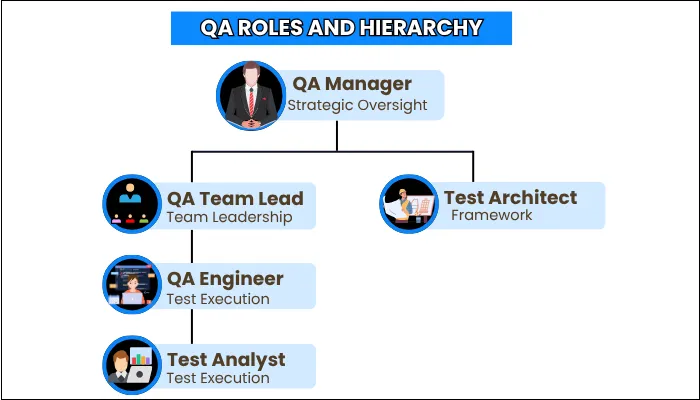
- QA Manager: Owns QA outcomes for the organization. Responsible for processes, budgets, resource allocation, and aligning QA objectives with business priorities. Builds and nurtures the team across distributed locations while maintaining executive-trustable reporting. Typically 10+ years of QA experience with strong leadership, negotiation, and decision-making skills.
- QA Team Lead: Handles tactical execution under the QA Manager. Manages cross-team dependencies, ensures sprint deliveries, and bridges strategy and operations. 6–10 years of QA experience with people-management capability and hands-on execution.
- Test Architect: The technical brain of QA. Designs resilient, reusable, scalable, modular frameworks, especially when systems integrate with multiple APIs and microservices. Selects tools, sets best practices for automation, and defines coverage standards. 8-12 years of hands-on QA experience with development or system architecture background.
- QA Engineer: QA Engineers perform test execution, design test cases, build automation scripts, and log defects, among other testing tasks. They are also the ones closest to the software, identifying usability gaps or overlooked risks that might otherwise go undetected.
QA Engineers need proficiency in manual and automation testing, knowledge of SQL and APIs, and familiarity with enterprise test management tools. Most QA Engineers have 2-5 years of experience, making them the workhorses of the QA function. - Test Analyst: Brings the business perspective. Translates business requirements into testable scenarios, validates workflows, and ensures testing aligns with real-world enterprise use cases. 3-6 years of experience with strong analytical skills, domain expertise, and requirements mapping capability.
Hiring all 5 QA Roles is taking too long? Get a Pre-Built Enterprise QA Team in 5 Days.
QA Team Structure Models - Centralized, Embedded, Hybrid, Outsourced
How a QA team is structured significantly impacts the quality, speed, and cost-effectiveness of enterprise software delivery. The structure determines how QA interacts with development, business stakeholders, and external partners. Here are the four most common structures:
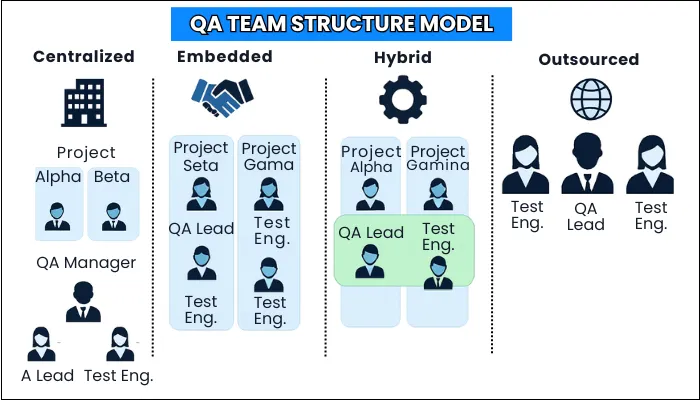
- Centralized Model: All QA resources consolidated into one dedicated department serving multiple projects across the enterprise. Best for organizations with complex portfolios, multiple stakeholders, and the need for uniform quality practices. Prevents repetition of effort and maintains consistent testing quality across systems.
- Embedded Model: QA professionals integrated directly within development teams. Testers work closely with developers, business analysts, and product owners from the start of the development lifecycle. Issues are caught earlier, reducing costly fixes. Test planning, execution, and automation align with sprint goals.
- Hybrid Model: Combines centralized and embedded. A central QA function defines strategy, tools, and governance while testers are embedded in development teams for daily execution. The central unit handles high-level functions (test strategy, governance, audit compliance) while embedded testers ensure early defect detection and faster delivery.
- Outsource QA: QA responsibilities partially or fully delegated to third-party service providers. Suitable for rapid scalability, cost reduction, or accessing niche expertise. Brings access to specialized tools, domain experts, and predictable cost. Best for software requiring rapid scaling, lacking internal expertise (security, performance), or seeking cost efficiency. See our managed QA services.
The Role of T-Shaped Skills in QA Team Structures
No matter which structural model an organization implements, the effectiveness of QA in enterprise software depends on individual team member skills. The T-shaped skills model is critical:
- Vertical Bar (Depth): Here, every tester has a core specialization such as performance engineering, compliance testing, automation, or security validation.
- Horizontal Bar (Breadth): Testers need working knowledge of adjacent areas. An automation engineer should also understand APIs and CI/CD pipelines. A compliance tester should be able to work with functional teams to validate workflows.
How to Build a Reliable Enterprise QA Team -5 Steps
To build a reliable QA team for enterprise software, you need to know the key roles, talents, and experience required, as well as how to structure their tasks to fit the needs of enterprise applications. Below is a detailed explanation of each key step and aspect:
- Appoint a QA Leader: The first and most essential step is to hire a QA Manager with 10-12 years of experience in QA roles and a minimum of 5 years in managing QA teams.
Furthermore, their expertise should cover an in-depth understanding of various testing methodologies, including functional, automated, security, compliance, and performance testing. - Understand Project and Organizational Needs: Once you have a dedicated QA leader, the next step is to engage with the project manager, product owners, and business stakeholders to understand the scope and complexity of the enterprise software. You need to analyze system architecture, dependencies, integrations, regulatory standards, deployment environments, and testing timelines.
Having a clear understanding of the requirements will allow you to shortlist team members based on the required skills and resources. - Hire Skilled Professionals: Prioritize candidates with proven track records in enterprise or regulated environments. Essential technical skills: Selenium, Appium, Cypress, JMeter, Postman, scripting for test automation, Jira/TestRail, Jenkins/Azure DevOps. Use job portals (LinkedIn, Indeed, Monster, Glassdoor) and referral schemes.
- Develop a QA Test Strategy: A robust test strategy will be your outline of the scope of functional testing across integrated systems, the extent of automation, and the inclusion of non-functional testing. In addition, you need to address test data management and environment provisioning, which can be challenging in enterprise software due to the multiplicity of platforms and external dependencies.
Here, you can also choose the right tools, which are critical to support complex testing needs.
The following are the top tools for the desired action:- Test Management: TestRail, Tricentis qTest, and Zephyr Enterprise.
- Functional and Regression Automation: Selenium, Cypress, Tricentis Tosca, and Telerik Test Studio.
- Performance & Load Testing: Apache JMeter, Tricentis NeoLoad, and BlazeMeter.
- API Testing: Postman, RestAssured, Karate, see our enterprise API testing services.
- Onboarding the QA Team: Now that everything is set, it's time to onboard the newly assembled QA team. Effective onboarding will introduce new QA members to enterprise-specific business goals, compliance rules, testing frameworks, tools, and workflows. It's crucial to clarify roles, responsibilities, communication methods, and quality metrics from the start.
See How ThinkSys Delivers an Enterprise QA Team at 30-50% Lower Cost than In-House Build.
Challenges in Assembling a QA Team
Building an effective QA team is a bumpy ride with several challenges waiting for you. These challenges can ruin all the efforts if you face them unprepared. With that in mind, the following are the key hurdles you’re likely to face while assembling your QA team.
- Finding Talent with Enterprise Domain Knowledge: A tester working on ERP finance modules must be familiar with accounting standards, whereas a QA analyst testing healthcare platforms needs to understand how HIPAA operates. In short, they need to have in-depth knowledge about the business as well as the technical side of things. Finding professionals who pair testing skills with deep domain knowledge is difficult, and training generalist testers can be time-consuming.
- High Demand for Advanced Technical Expertise: The current testing scenario encompasses more than just manual testing. The team must design automation frameworks, run performance tests, validate integration with third-party systems, and conduct penetration testing. The talent market for highly trained QA engineers is competitive due to rising demand, making hiring expensive and time-consuming.
- Retaining Skilled QA Professionals: Enterprise QA is a long-term endeavor that requires stability and extensive system understanding. However, skilled QA engineers often move into roles in automation development, product management, or DevOps, leading to high turnover.
The tech industry, in general, experiences one of the highest turnover rates, with an average of 13%, making it a constant challenge to maintain a consistent, experienced team. - Location and Distributed Team Constraints: With remote working normalized, teams function across multiple locations for round-the-clock service. Hiring the right talent in specific geographies is another challenge, especially when local markets lack QA maturity. In addition, maintaining clear communication and collaboration is another tussle.
Upskilling Team the Right Way
There's a fine line between an average QA team and an effective enterprise QA team. The difference shows when technology shifts. Only teams capable of upskilling deliver consistent results long-term.
- Understand Skill Gaps: The first step of improvement is understanding where they lack. You need to identify where the team currently stands versus where they need to be. For that, you can conduct skill assessments, review past testing issues, and map them against upcoming project needs to attain a clear picture. Without this diagnosis, training efforts risk being generic rather than impactful.
- Align Learning with Career Growth: Upskilling should never feel like a chore. To ensure that never happens, you should align new skills with individual career goals. QA engineers aiming for leadership roles may focus on test strategy and stakeholder communication, while others may specialize in security testing. By linking training with career progression, you ensure higher employee retention.
- Build an Internal Learning Culture: Learning should begin internally and is considered among the fastest ways to bridge gaps. Make sure to motivate experienced QA engineers, architects, and leads to mentor their subordinates on enterprise challenges. And, don’t limit this knowledge sharing to technical skills, but focus on collaboration and team cohesion to actually build this culture for future growth.
- Leverage External Training and Certifications: There is no denying the fact that internal learning is practical, but it has certain limitations. External specialized training programs, certifications, workshops, hackathons, and seminars add rigor and expose teams to industry best practices, giving them valuable skills.
- Implement Continuous Tracking of Progress: One of the key parts of upskilling the team is tracking the process through measurable outcomes. Team leads can set up skill matrices, performance dashboards, goals, and quarterly reviews to monitor growth, ensuring accountability and highlighting effective learning efforts.
Build vs Buy vs Partner - Enterprise QA Team Strategy
For enterprises, the final and most critical decision is how to acquire the necessary QA talent and expertise. The choice directly impacts speed, cost, and quality of transformation. You have three approaches: build in-house, fully outsource, or use a hybrid partnership.
| Factor | Build an In-House Team | Outsourcing | Hybrid Approach |
| Control | In-house teams offer full control but demand heavy leadership and governance. | There is less control, though vendors follow defined SLAs. | Shared control with strategic alignment, ensuring enterprise priorities are respected. |
| Customization | Customization is possible, but dependent on internal bandwidth and specialist availability. | Vendors adapt proven frameworks to enterprise needs. Customization is available but within limits. | You can co-create strategies tailored to your enterprise architecture and compliance needs with the partner. |
| Expertise | In-house expertise is limited by the resources that can be hired and retained. Specialized skills are hard to sustain. | It gives quick access to skilled testers in automation, security, and performance. | Partners bring deeper domain expertise and ensure continuous upskilling. |
| Scalability | In-house scaling takes time due to hiring and onboarding cycles. | These teams scale up or down quickly with project demand. | Partnerships scale flexibly while aligning with enterprise growth. |
| Cost | In-house teams carry high upfront and ongoing costs. | Outsourcing has predictable costs and low upfront investment. It delivers strong short-term ROI. | Partnerships share investments and deliver compounding ROI over the long run. |
| Best Fit For | Enterprises with large budgets, mature processes, and low urgency. | Enterprises needing speed, flexibility, and cost-effectiveness. Useful for large-scale or short-term needs. | Enterprises focused on long-term quality, innovation, and domain alignment. |
Get a Free Enterprise API Testing Audit. We will Map Your Current Coverage and Identify the Gaps.
Conclusion
An enterprise QA team is no longer the last step in development , it's a strategic function that determines whether your software ships reliably, scales with demand, and meets compliance requirements that increasingly carry seven-figure penalties for failure.
You now understand the skills, structures, roles, and challenges that define effective QA teams, and the three models for acquiring that capability: build, buy, or partner.
The future of QA is continuous transformation. AI and automation are expanding testing coverage while reducing manual effort. Continuous testing is becoming the norm in DevOps pipelines. Compliance is being integrated into test design from the start. Teams are increasingly built around T-shaped skill sets.
But the reality for most enterprises: building and retaining teams with this diverse expertise takes years, leaving the business vulnerable to slower releases, higher costs, and compliance exposure during the rebuild.
The fastest path forward is partnership. With a specialist QA provider like ThinkSys, you gain access to skilled engineers, scalable team structures, enterprise tooling, and domain expertise that adapts as technology evolves, without the 12–18 month internal build cycle.
Talk to our Enterprise QA Experts about Building Your Team or Outsourcing Strategy.