Agile Software Development Life Cycle: Methodology, Examples
Summarize With:


Definition
The Agile Software Development Life Cycle (SDLC) is an iterative methodology that delivers working software in short cycles called sprints (1–4 weeks). It has four core phases: Planning, Design, Development, and Testing/Deployment which repeat across each sprint. Unlike Waterfall, Agile incorporates continuous stakeholder feedback throughout development rather than validating requirements upfront and only testing at the end.
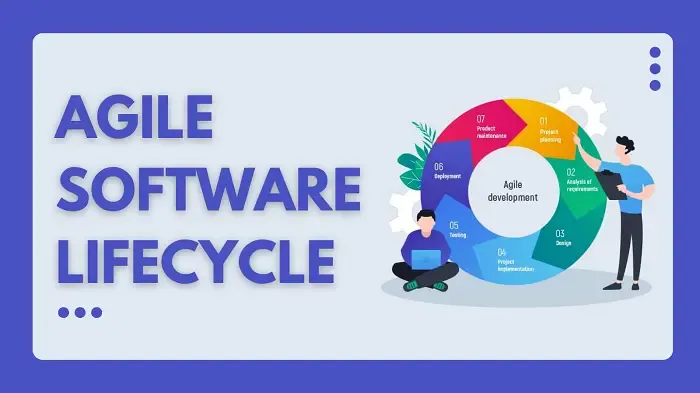
This guide covers the Agile SDLC methodology, its phases, real-world examples from companies like Amazon, Netflix, and Microsoft, and how ThinkSys helps organizations implement Agile effectively.
Overview of Agile Software Development Life Cycle and its Methodology
Agile software development is a methodology that delivers working software in repeated short cycles (sprints), incorporating customer feedback at every stage. The Agile SDLC consists of four phases that repeat iteratively across each sprint:
- The planning stage of the development life cycle is where project-specific requirements are identified, and a roadmap is created to meet those requirements. During this phase, a team may review market trends, customer feedback, and any other resources that can be used to determine the needs of their product. The team will move on to the design phase once the plan has been created and approved by stakeholders.
- The design phase of the Agile development process focuses on creating a user interface and developing features to meet customer requirements. During this stage, developers may also consider any functionality or features users need. During this phase, teams must also create detailed specifications for the software and present them to stakeholders for approval.
- The development phase of Agile software development is where the bulk of the coding and development will occur. Developers will create code that meets the user requirements, test it against predetermined criteria, and then refine their work to ensure the highest quality product possible.
- Finally, once all code has been tested and all customer requirements have been met, the team will enter the testing/deployment phase. During this phase, testers must perform various tests to ensure the product meets all expected performance expectations before being deployed for public use.
Each sprint produces a potentially shippable product increment. This cycle repeats every 1–4 weeks, allowing teams to adjust direction based on what they learn.
Agile SDLC vs Waterfall - Key Differences
Understanding where Agile outperforms Waterfall and where it doesn't - is the first step to choosing the right methodology for your project.
| Agile SDLC | Waterfall SDLC | |
|---|---|---|
| Delivery model | Incremental- working software every 1-4 weeks | Sequential- full product delivered at end |
| Requirements | Evolve based on feedback throughout development | Defined and locked at the start |
| Testing | Continuous - every sprint | Single phase at end of development |
| Stakeholder involvement | Every sprint review | Primarily at start and end |
| Change handling | Accommodated in next sprint | Costly and disruptive mid-project |
| Risk | Distributed - caught early per sprint | Concentrated - discovered late |
| Best for | Products where requirements evolve | Fixed-scope projects with stable requirements |
| Documentation | Lightweight and working | Comprehensive upfront |
When to choose Waterfall over Agile: Projects with regulatory fixed-deliverable contracts, hardware manufacturing timelines, or government procurement requirements where scope cannot change mid-project.
Advantages of the Agile Development Model:
- Increased Efficiency: Agile software development methodology allows organizations to respond quickly to changing customer requirements and prioritize the most critical tasks first. This allows teams to produce a product in shorter periods than traditional methodologies, leading to faster time-to-market, greater profits, and improved customer satisfaction.
- Improved Quality: Agile development teams can iterate quickly and incorporate feedback from stakeholders early on in the process. This allows for improved product quality due to more thorough testing, greater attention to detail, and better overall user experience.
- Reduced Risk: Agile software development methodology uses short sprints with well-defined objectives that can be completed quickly and with fewer risks. This allows teams to identify and fix potential issues early in the process and fix them before they become significant problems.
- Improved Collaboration: Agile development methodology encourages open dialogue between teams, stakeholders, and customers, which helps ensure that everyone is on the same page and focused on meeting project objectives. This fosters a spirit of collaboration and creativity, which leads to better solutions.
- Increased Agility: One of the essential advantages of Agile software development is its ability to adapt quickly to customer needs and market changes. This allows teams to stay ahead of their competition while minimizing the risks of responding too slowly.
Disadvantages of the Agile Development Model:
- Lack of Long-Term Planning: One of the main disadvantages of the Agile development model is that it needs long-term planning. Although the short-term goals are achievable, there is no guarantee that they will lead to a successful overall outcome. This means that developers may need help predicting how their work will fit into the larger project and what resources will be needed in the future.
- Costly in the Long Term: If a project is not managed correctly, making changes throughout the development process can be costly and time-consuming. This is especially true when developers are required to refactor code or adjust plans as they go along. Plus, adjusting the budget and timeline can be difficult if resources become available during the process that could have been used earlier.
- Difficulty in Large Projects: While Agile has proven successful for small-scale projects, it can be challenging to implement in larger ones. Managing multiple teams, organizing resources across departments, and tracking changes become significantly more complicated in these cases. Additionally, there may be more pressure to deliver results on time and within budget, making accommodating iterations or unpredicted changes challenging.
- Limited Documentation: Documentation is integral to software development, but Agile's focus on short-term results often leads to limited documentation. This can make it difficult for new developers to understand existing code and makes it more challenging to maintain the application in the future. Additionally, if changes need to be made or issues need to be debugged quickly, a lack of documentation can pose a significant obstacle.
- Imbalance of Power: The Agile model generally gives more power to the development team, which can lead to problems if not appropriately managed. Without a clear structure that defines roles and responsibilities, teams can become stagnant or even resistant to new ideas. Additionally, developers may be reluctant to provide constructive feedback or suggest changes due to fear of retribution from managers.
Overall, the Agile development model is a powerful tool for software developers but has drawbacks. With proper management and clear goals in place, however, these issues can be minimized, and the advantages of this methodology can be fully realized.
Examples of Real-World Implementations Using the Agile Methodology
The Agile software development life cycle, or Agile methodology commonly referred to, has become the standard for most modern technology projects. This model focuses on incremental and iterative development with short feature development and deployment cycles to speed up the process. Here are a few examples of how this methodology is being used in today's technology world:
- Amazon is one of the top e-commerce companies in the world and relies heavily on the Agile methodology for their software development. In particular, they use Scrum, a popular Agile framework. This incorporates short sprints to produce new features, emphasizing collaboration between teams quickly.
- Another company using Agile is Microsoft, which uses what they call "sprints" to deliver software updates quickly. This allows them to focus on small chunks of work and move quickly through each cycle.
- Netflix has also adopted the Agile methodology for its product development, as they believe it is the best way to stay ahead of the competition. They use an agile framework called Kanban that enables them to have visibility into their projects and quickly develop features.
- Uber also uses Agile development, focusing on small teams working together to quickly build out new features while receiving customers feedback.
These are just a few examples of companies using Agile to deliver products and services quickly. This methodology has become the preferred model for software development in today's digital world.
Agile has several advantages over traditional methods, including improved customer satisfaction through continuous feedback, increased speed of development, and better collaboration between teams. However, it also has some drawbacks that should be considered before implementing this methodology.
New Innovations in The Model Have Been Introduced to Improve Its Effectiveness
Thanks to its advantages over traditional models, agile software development has become the preferred methodology for many technology companies. This model emphasizes transparency, collaboration, and flexibility to deliver quality products quickly and efficiently. Over the years, innovations have been introduced to improve the effectiveness of this development life cycle even further.
- One such innovation is the use of automated testing. Automated tests are used to check code quality and quickly identify any errors or bugs. This helps ensure that software runs smoothly and is not affected by potential inconsistencies in development processes. Additionally, automated tests can be used to construct regression tests, confirming that changes made during a particular iteration have not caused unintended side effects.
- Another major innovation that has been introduced in the Agile software development life cycle is continuous integration. This process involves combining frequent code builds into a single release, enabling teams to iterate more quickly and avoid costly delays associated with traditional waterfall models. Additionally, continuous integration helps ensure quality by allowing developers to test entire features before they are released in a production environment.
Finally, Agile software development methodology has also shifted to embrace DevOps principles. This includes using automated pipelines and other tools that allow teams to quickly deploy changes into production environments with minimal effort and risk. DevOps also enables developers to develop and execute code faster by removing manual steps.
Agile SDLC in 2026: AI-Assisted Development
The Agile methodology has evolved significantly with AI integration. Here are the key changes affecting Agile teams in 2026:
- AI-Augmented Sprint Planning: AI tools now analyze historical sprint velocity, team capacity, and backlog complexity to recommend sprint scope automatically. Tools like GitHub Copilot Workspace and Jira's AI features can pre-populate sprint estimates based on past performance data.
- Automated Testing in the Agile Loop: Automated testing has become a prerequisite, not an option. Teams using continuous integration pipelines with automated test suites (Playwright, Selenium Grid, or Cypress for browser tests) cut regression time by 40–60% per sprint. This makes Agile's rapid iteration genuinely sustainable at scale. See our guide to test automation services for implementation patterns.
- AI-Generated User Stories: Product teams are using LLMs to draft user stories from customer feedback, support tickets, and feature requests then refining them in sprint ceremonies. This reduces the planning overhead that traditionally makes Agile ceremonies feel heavy.
- Agile at Scale: SAFe and LeSS (2026 Update): For enterprises running 5+ Agile teams, Scaled Agile Framework (SAFe) remains the dominant coordination model. Lightweight Scrum (LeSS) is gaining ground in companies wanting lower process overhead. Both frameworks have incorporated AI-driven dependency mapping to reduce inter-team blockers.
How ThinkSys Help You Implement Agile in Your Organization
ThinkSys has implemented Agile frameworks for software development and QA teams across the US, UK, and APAC regions. Our engagements typically reduce time-to-release by 30–45% in the first two quarters of Agile adoption, based on project delivery metrics from our client engagements.
- Agile consulting and framework selection: Scrum, Kanban, SAFe, or hybrid based on your team size and release cadence
- Sprint structure design: defining ceremonies, roles, and Definition of Done that fit your engineering culture
- CI/CD pipeline integration : connecting your sprint delivery to automated build, test, and deployment pipelines
- QA integration into sprints : embedding software testing within the development cycle rather than as a separate phase after development
- Product roadmap development aligned with sprint capacity and business objectives
- Metrics and reporting systems that track sprint velocity, defect escape rate, and deployment frequency
- Ongoing coaching post-implementation to ensure Agile practices are sustained, not abandoned after the first quarter
With ThinkSys, you can rest assured that your organization will implement Agile efficiently and effectively. We have the resources and knowledge to help you make the most of this robust framework.
Contact us today to find out more about our Services.
Frequently Asked Questions
What are the phases of the Agile software development life cycle?
The Agile SDLC has four phases that repeat in each sprint: Planning (requirements identification and sprint scope), Design (UI and technical architecture), Development (coding and unit testing), and Testing/Deployment (QA verification and release). Each sprint lasts 1-4 weeks and produces a working product increment.
What is the difference between Agile and Waterfall development?
Agile delivers working software incrementally every sprint, with requirements evolving based on feedback. Waterfall follows a sequential process : requirements, design, development, testing with the full product delivered at the end. Agile handles changing requirements better; Waterfall suits fixed-scope projects with stable requirements and regulatory fixed-deliverable contracts.
How long is a sprint in Agile development?
Sprints typically last 1-4 weeks. Most teams settle on 2-week sprints, short enough to maintain fast feedback cycles, long enough to complete meaningful features. Teams with stable, well-understood backlogs often use 1-week sprints. 4-week sprints are common in hardware-adjacent or compliance-heavy projects where change cycles are naturally longer.
What is the difference between Agile and Scrum?
Agile is the methodology , the set of values and principles defined in the 2001 Agile Manifesto. Scrum is a specific framework for implementing Agile, with defined roles (Product Owner, Scrum Master, Development Team), ceremonies (sprint planning, daily standup, sprint review, retrospective), and artefacts (product backlog, sprint backlog, increment). Kanban and SAFe are other frameworks for implementing Agile principles.
What is the role of QA in Agile development?
In Agile, QA is embedded within each sprint rather than treated as a final phase. QA engineers participate in sprint planning to review acceptance criteria for testability, write and execute test cases during the sprint, run automated regression tests on every build, and sign off on the Definition of Done before the sprint ends. This shift-left approach catches defects in the same sprint they are introduced.
Is Agile suitable for large enterprise projects?
Yes, but it requires a scaling framework. Single-team Agile (Scrum or Kanban) works well for teams of 5–10 people. For multiple teams working on a shared product, frameworks like SAFe (Scaled Agile Framework) or LeSS (Large-Scale Scrum) coordinate inter-team dependencies, shared backlogs, and program-level planning while preserving team-level sprint autonomy.
Conclusion
Agile software development is an effective and popular methodology that enables teams to respond quickly to changing market needs. It has been around for over two decades now and continues to be improved upon with innovations such as DevOps. The advantages of using this method are numerous.
However, there are also some drawbacks associated with this approach, which must be considered when deciding whether it's suitable for your project. With careful planning and implementation, you can reap all the benefits of a successful Agile software development process while avoiding common pitfalls.
Contact our Experts to Implement Agile in Your Organisation.